
Ways of organising for sustainability transformations
Everyday actions matter across scale
– (O’Brien et al., 2023)
A reflective story
My PhD journey begins by understanding the need to move beyond the technological fix approach to sustainability transformations, moving to the idea that mindsets, paradigms, values and worldviews constitute a deep leverage point for transforming ourselves, and societies. Failed attempts to address the scale and complexity of sustainability challenges, has led to a sense of helplessness among many (O’Brien et al., 2023). What we need instead is empowered individuals and groups that drive systemic and cultural transformations across scales.
I have specifically been looking at Social Economy organisations as they represent the seeds of a radically different economy. What is the social economy? It encompasses cooperatives, mutual societies, foundations, associations, paritarian institutions, and social enterprises. These organisations act in several economic sectors (healthcare, education, tourism, renewable energy, agrifood, cooperative housing, culture, sport and leisure, etc.). Most importantly they work against the economic growth paradigm by putting people over profit and reinvesting surplus into economic and social objectives thus contributing to sustainability transformations (https://unsse.org/sse-and-the-sdgs/).
Social economy organisations have always acted upon sustainability principles. And their doing has been a vehicle for transforming communities. Now it has been recognised that “practice” need to be matched with a cultural process aimed at changing the idea of the inevitability of a development model cantered on profit; at creating and popularizing places of expression of active citizenship; at giving new life to democratic and political participation.
What to do then? In the summer of 2023, I moved from Italy to Sweden to start a period of research at the Design Department under the mentorship of Åsa Ståhl. In getting to know each other, we participated in a Community Economies practise retreat. The movement questions how academic practices can contribute to the exciting proliferation of economic experiments occurring worldwide in the current moment. During the retreat, I familiarised myself with scholar activism (Gibson-Graham, 2008). At the same time, I have experienced a process of capacity building for individuals and organisations involved in change work.
What I took away from it is an experimental attitude towards the objects of my research (Gibson-Graham, 2008). In other words, I am now trying to learn social economies’ strategies to promote change, support their efforts to learn from their experience and help them find ways of changing what they wish to change. All academics, no matter their discipline, have a role in this, for there is no research on a dead planet (Thierry, Horn, Hellermann & Gardner, 2023).
Among the international connections made through my staying at LNU, there is Eeva Houtbeckers, a fellow activist scholar. In a conversation we had, we acknowledged that in researching “who does the work of transformation now” it is unfair to put the pressure on one societal stakeholder. Social Economy Organisations are not the silver bullet. But economic diversity offers a chance for multiple ways forward.
How?
While reshaping my academic self (de Knecht, van der Meer, Brinkma, Kluijtmans, & Miedema, 2021) I also established a research practice strongly entangled with relations and contexts. Staying alive, for every species, requires livable collaborations. Collaboration means working across difference, which leads to contamination (Tsing, 2015). I was at first flying in the dark until my mentor/colleague Åsa Ståhl pitched me through some of her contacts. Similarly, I rekindled old networks, formed during my previous time in Sweden as a Master student. Additionally, I cultivated new ones thanks to university colleagues like Sara Gottschalk who has introduced me to the Institute for Degrowth Studies, an “ideell förening” in Malmö. In this way, I have been able to host workshops and carry out interviews, both in Malmö and in the Småland region, to collect the stories and points of view of different local organisations engaged in change work. The workshops represented learning hubs allowing for reflection on ways of organising for sustainability transformations. What values, structures, capacities, collaborations, narratives, business models, regulations can sustain change work? How can each of us find agency?
To organise the workshops I worked co-creatively with other stakeholders, such as research groups, academics and universities, students, and local groups.
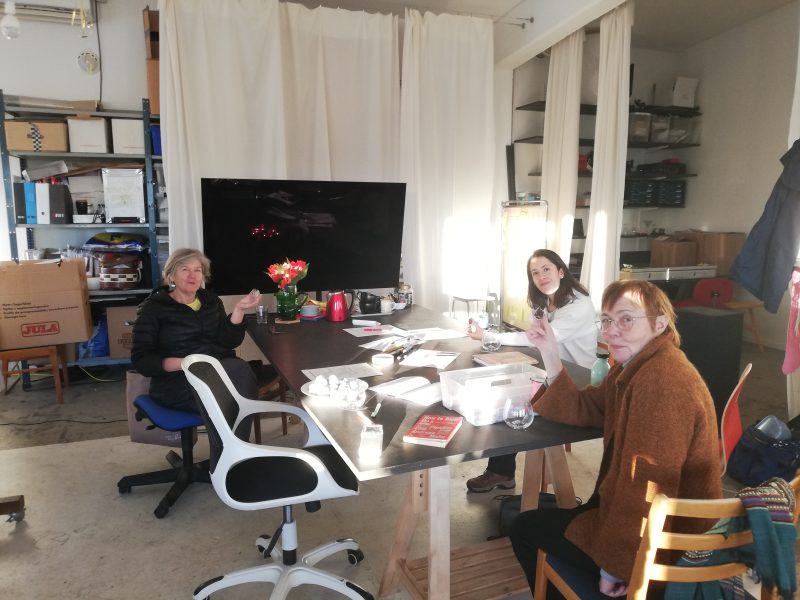
The first workshop took place in a studio shared by designers and artists in Malmö. It involved, from the left Ann Light, Camila Rosado and Gunnel Pettersson. Ann Light is a designer researching on capabilities needed to reveal and articulate radical interdependencies between humans and more-than-humans. Camila Rosado is a human geography student at Lund University who is doing an internship in Botildenborg, an urban farm and social place. Gunnel Pettersson drives Odlingen a presentation and a gathering place for art projects. Image Credits: Silvia Mugnaini.
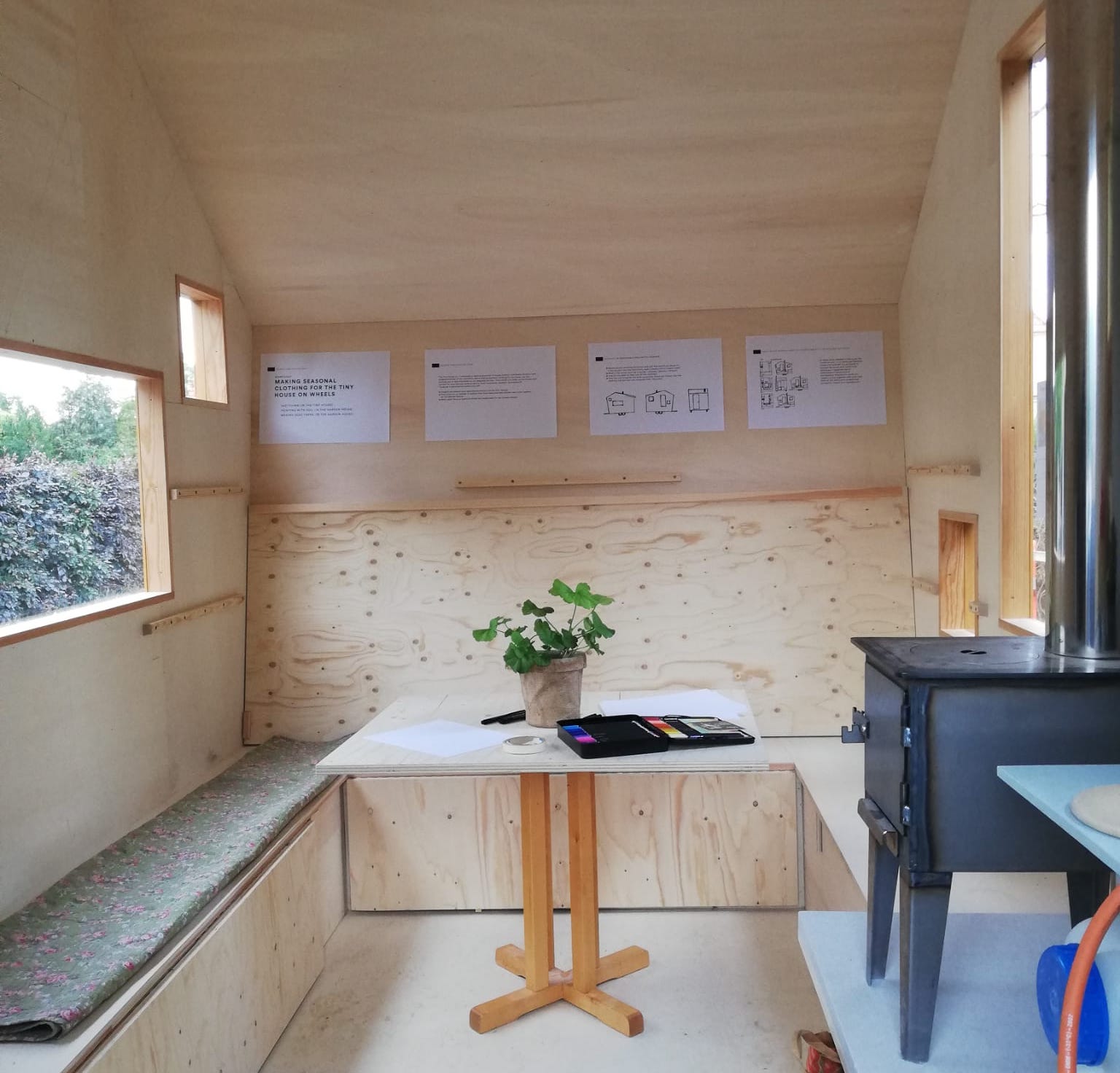
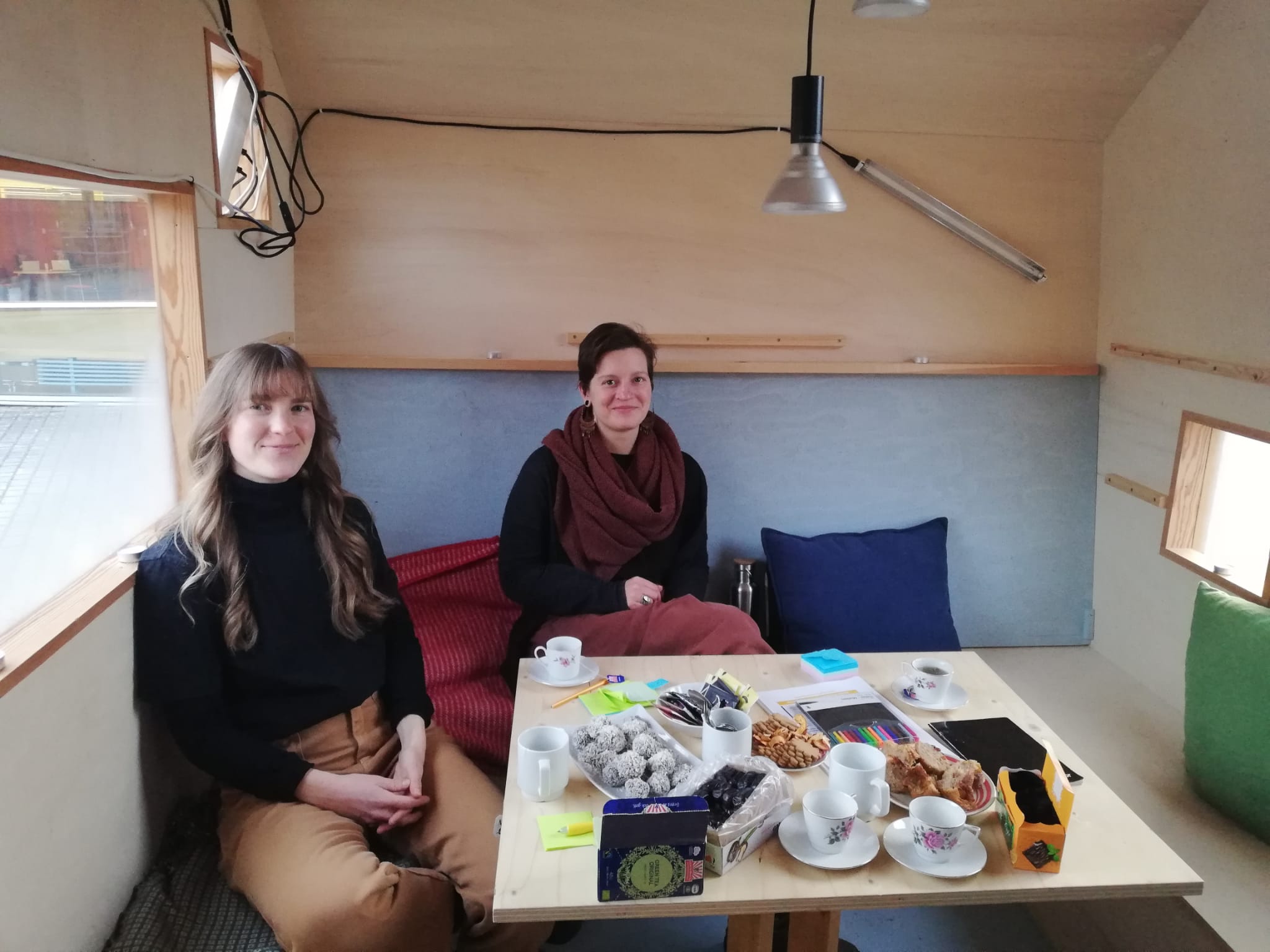
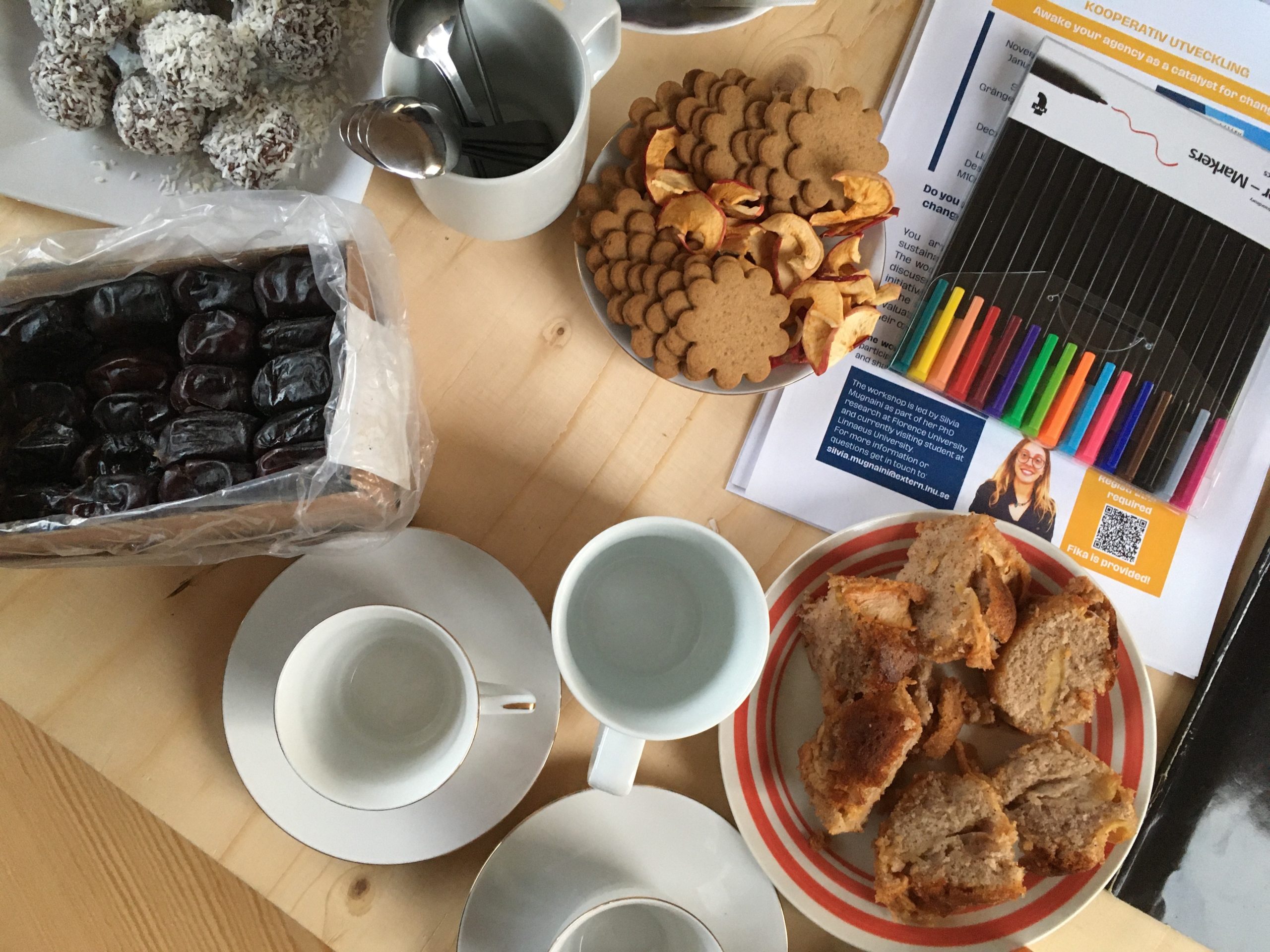
The second workshop was hosted in the Tiny House on Wheels outside of the Design Department. The THoW is part of an LNU research project named “Holding Surplus House” involving Åsa Ståhl, Stephan Hruza and Svenja Keune. Workshop attendees included Leah Ireland, LNU alumni and co-founder of The Feminist Farmers, Rut Kallman from Smålands Trädgård and Mariana Johannesson former member of Macken, a local cooperative in Växjö. The THoW created the socio-material circumstances of an imaginative starting place for brainstorming and building new worlds. Image Credits: Silvia Mugnaini.
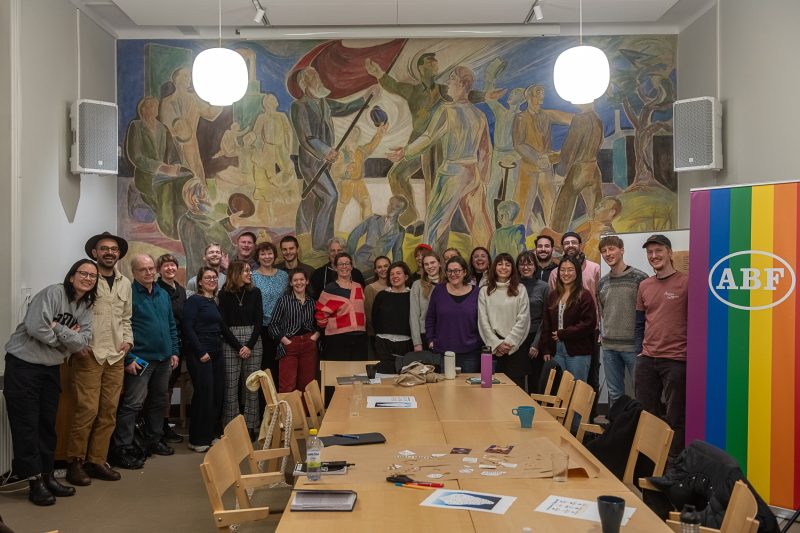
The third workshop was hosted together with the Institute for Degrowth Studies in Malmö. Local organisations that joined are Circle Centre – a library of goods in Lund –, Matvarukooperativ – a member-run cooperative that delivers fresh, organic, local food at an affordable price while supporting local producers –, Alnarp’s Agroecology Farm – a student farm. @Image Credits: Philipp Montenegro
What?
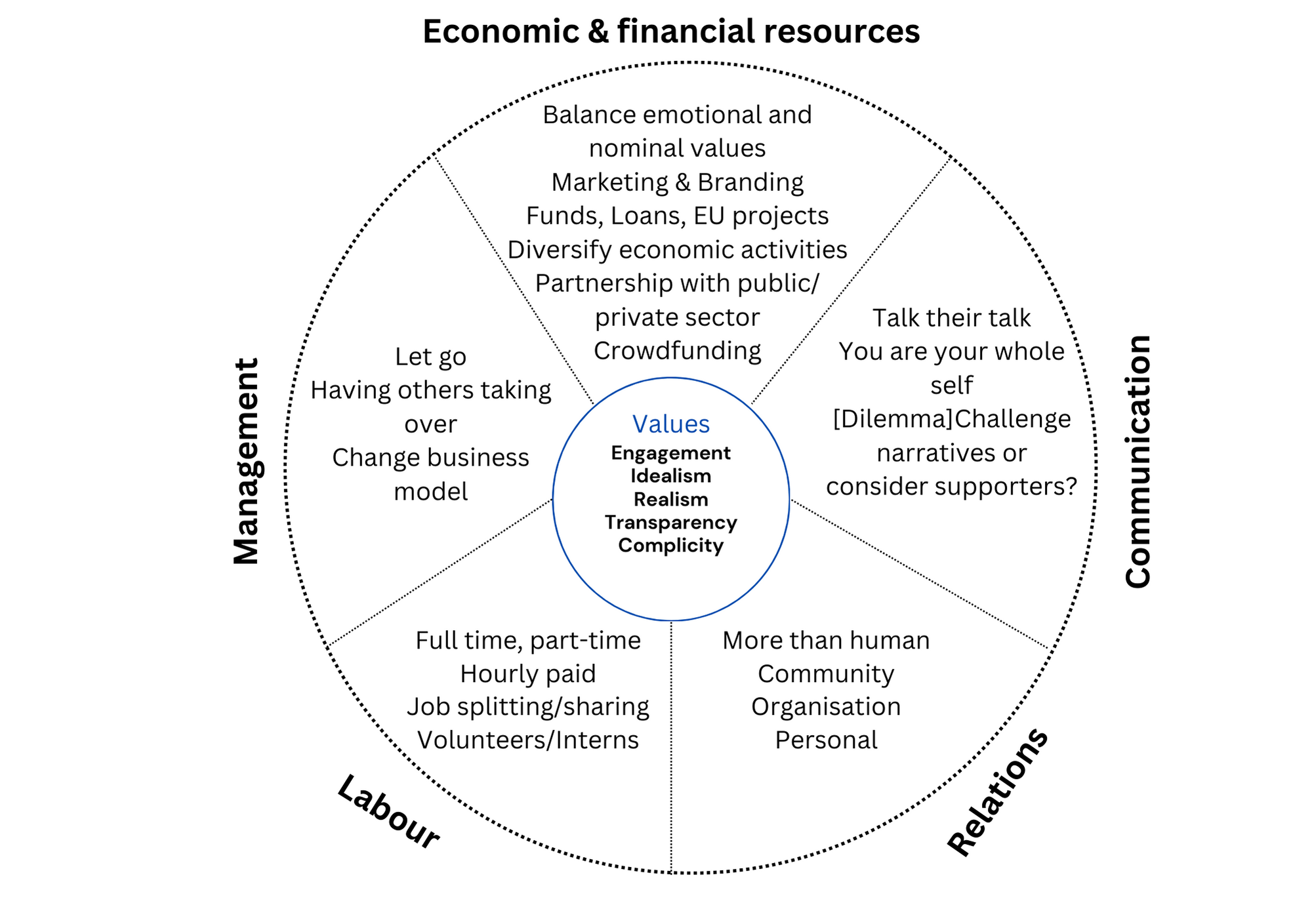
The workshops generated a range of visual and verbal material. Sense making of this material took place iteratively. After each workshop a summary was shared with the participants to make sure that the interpretations were meaningful and of relevance. In conclusion, a clustering of ideas has been assembled on how to organize social economy organisations working on sustainability transformations. The conversations carried out with different organisations show ways to gather financial resources, modes of providing labour, values upon which to build an organisation, how to communicate to get external support and how to cultivate healthy relationships.
Here you can listen to some extracts from these conversations highlighting relationships, struggles and positionality.
“Our mindset is if we bring in someone to cut grass for example I don’t tell them how to cut grass and I don’t expect them to cut grass as they would do it in your garden. But they need to understand what does best to that place and to the guests we host. So Martina, who cuts grass, does it entirely independently. So she knows what is the best moment in a month, or what is the best weather, rain or not rain, what kind of clients we get and guests and then she erates the grass area from circles into lines which again enables the energy to flow. No one tells her how to do it and when to do it. She does it. And no one asks for proposals from her when she has to quote her service. No, we pay. Because we believe she is a team member and she knows best and we don’t need to supervise her. But we see the outcome” (Martin Studer, Mundekulla).
“Och jag tror att jag har inte gått in i detta som en idealist. Alltså ska jag skapa ett professionellt företag så kan inte jag vara idealist. Jag måste vara realistisk liksom. Och jag vänder mig också emot den här tanken att allt socialt arbete som vi ska göra ska hela tiden vara ideellt. Jag tror inte på det. Jag har startat en massa volontärarbete tidigare. Folk är kvar en månad, sen orkar de inte längre. Så jag tror att vi måste lämna det lite. Det är ingen som förväntar sig att en läkare ska stå och gipsa ett ben gratis. Men vi förväntar oss alltid att människor som jobbar som psykolog, psykoterapeut och psykosocialt ska jobba gratis. Varför då? Vi måste bygga våra sociala företag professionellt från början. Vi måste våga vara professionella och vi måste våga se att det relationella arbetet med barn och ungdomar måste få kosta pengar. Vi kommer aldrig komma vidare och göra ett professionellt jobb om allting ska bygga på gratisarbete.” (Natalie Takvam, Iris).
Takeaways
After these 6 months, I learned that we need to dare to create a momentum for change. New worlds are already in the making. To perform them we need radical co-presence, we need each other, we need to transparently make mistakes but also celebrate the wins. We need care for ourselves, our organisations, communities and more than humans. To survive we need to be able to stand on different legs (not just two as in a human form but more like an octopus), we need to be creative and try out even in the face of uncertainty. Finally, we need to communicate what we do with openness and courage to engage new allies.
References
de Knecht, S., van der Meer, M., Brinkma, L., Kluijtmans, M., & Miedema, F. (2021). Reshaping the Academic Self. Connecting education & open science. Utrecht University.
Gibson-Graham, J. K. (2008). Diverse economies: performative practices for other worlds’. Progress in human geography, 32(5), 613-632.
O’Brien, K., Carmona, R., Gram-Hanssen, I., Hochachka, G., Sygna, L., & Rosenberg, M. (2023). Fractal approaches to scaling transformations to sustainability. Ambio, 1-14.
Thierry, A., Horn, L., Von Hellermann, P., & Gardner, C. J. (2023, October). “No research on a dead planet”: preserving the socio-ecological conditions for academia. In Frontiers in Education (Vol. 8, p. 1237076). Frontiers Media SA.
Tising, A. (2015). The Mushroom at the end of the world: On the possibility of life in capitalist ruins. Princeton University Press.
Discover the people who have shaped this work
Odlingen https://odlingen.org/content/english-summary
Botildenborg https://www.botildenborg.se
The Feminist Farmers https://www.instagram.com/thefeministfarmers/
Smålands Trädgård https://smalandstradgard.com
Institute for Degrowth Studies https://www.facebook.com/institutefordegrowthstudies/
Circle Centre https://www.circlecentrelund.org
Matvarukooperativ https://www.kooperativet.org
Alnarp’s Agroecology Farm https://www.alnarpsfarm.se
Iris Markaryd https://www.iris-markaryd.se
Eeva Houtbeckers https://eevahoutbeckers.fi
Ann Light https://mau.se/en/persons/ann.light/
↑ Top