
Image above: Split-vision into entanglements and interconnectedness of a design+change-course, imaginaries of design educations, histories and futures of socio-ecological change work. Photo: Åsa Ståhl.
Reparatory approaches in a design classroom and beyond
Introduction
Autumn 2022: I entered the classroom to teach and learn in the Design+Change-course. It was the fourth time I was involved in this course. It meant that I I could build on previous work, but also embrace the ongoing learning. I had my mind set on the students, but also allowed myself a split-vision. The plastic cover for an electrical socket on a wooden hanger caught my attention. The word “data” written on the left-hand lower corner of the plastic cover. A security wire attached to the hanger. It followed me during the whole semester: broken energy flows as an opportunity to unlearn, unmake and make space for change agency in the near and close at hand, as well as the more distant.
Change is in the name of the programme. The approach is that change can take place anywhere. The third-year students, the teaching team and I stepped into the joint semester to work on how to develop change agency as designers. The topic for the semester was fair share of domestic surplus. By pointing out the domestic, the idea was to bring change close to home. For example, inside the walls where you do much of the basics in life: eat, sleep, hang out. But also: the university, thinking of it as a shared home where we practice living together, negotiate and take care of each other. And, not the least, the grand planetary scale: our shared home on Earth (Tham et al 2019). This idea of patterns repeating across scale, recognizing interdependence between actors, levels and practices, and valuing different scales for what change we can make in each situation. Taken together, I think of it as fractal scaling (O’Brien 2023 et al).
In-between the everyday chores of teaching and researching at the university the assemblage with the broken electrical cover kept coming back in my sight and my thoughts. It was a picture I had not chosen, but one that seemed important to reflect on for our international Design + Change-educations in its particular location: at the design department at Linnaeus university, southern Sweden, northern Europe. The assemblage of plastics, metal, wood, words seemed to be an excellent entry point into repair of things, thoughts, and ways of working. Sometimes the broken assemblage came across as demotivating, such as when I associated it with the fear I had felt in the classroom in March 2022 in the beginning of the Russian full-scale invasion and, more particularly, occupation of the Zaporizhzhia nuclear power plant in Ukraine (Borger 2022). On other occasions I picked up on the positive spirits of what change the broken can make space for. As an educator, researcher, and employer, I ask myself continuously: what change is possible and necessary for me, for the students, for the academic institution and our collaborators to contribute to planetary multispecies flourishing? How do we adequately answer to the insights put forward by, for example, Thierry and co-authors (2023) captured in their paper title: “”No Research on a Dead Planet”: preserving the socio-ecological conditions for academia”.
Situated emerging design practices as responses to contexts
In September 2022 many of the students in the international cohort had become aware of how individuals are interconnected across time and space through, for example, electric infrastructures. At the time, there was an intense public debate on the pricing of electricity in Sweden and how it hit against the private economy. It is reportedly more difficult to creatively suggest subtractions rather than additions (Adams et al 2021), but from EU-level we heard already in April 2022 that we had to withdraw from previous energy usage. The European Commission and IEA wrote: “Most households are also experiencing higher energy bills because of the energy crisis exacerbated by the war. Using less energy is not only an immediate way for Europeans to reduce their bills, it also supports Ukraine by reducing the need for Russian oil and gas, thereby helping to reduce the revenue streams funding the invasion.” (IEA, paragraph 3). In other words, the message was that we all have agency in our everyday lives, not just by adding, like most designers are trained to do, but also seek other designerly ways to make change.
For Design + Change values that guide our designing, resources we use in the designing, and the distribution thereof, are always in focus but without any simple, certain design answers. As designers we must thus actively choose the futures we want to contribute to, for example by being aware of what kind of design practices and what kind of histories we want to build on. We must also dig into ourselves and calibrate in relation to others to find values that act as baselines for our decision making. And we cannot be sure to agree, but we must be prepared to negotiate and accept difference. An early learning activity in the semester was thus to make an inventory of resources that the students brought with them: knowledges, skills, values. The inventory was done in a shared online document. In a double-move the students thereby made their luggage present and started to map their collective resources as a collective.
One of the first conceptual inputs and challenges in the semester stems from oikos. Oikos can mean habitat, dwelling, home, house, household, and household management and is at the root of both economy and ecology. It is introduced for example through referencing the design project BOOST metadesign, the book Oikology – Home Ecologics (Tham et al 2019) and the community economies institute (see for example Gibson-Graham et al 2015 and Ståhl 2019). These resources are all setting the scene for, first off, learning to see the eco-socially dire state of our planet and to, secondly, act with what we have at hand.
This contextualisation gives grounds for diverging from, for example, massproducing industrial design. Emerging design practices that take another approach to resources than that of producing and using the new could, for example, be repair, maintenance, composting, caring, un/making. Student work in our programmes have gradually shown the way towards emerging design practices. BA-thesis in the Design + Change-programme is a testament and one way to trace the move the students have made (see for example Ratzinger 2018, Briland 2018, Ireland 2019, Fähndrich 2020, Hallgrímsdóttir 2020, Shen 2020, Czekajska 2021 and Fahd & Bsirini 2021, Braun 2022). Most can also be seen in our online design portfolio: The department’s Instagram account also shows previous student work from the Design + Change-semester (published in the autumn 2021):
https://www.instagram.com/p/CQBLhO6pE3t/
https://www.instagram.com/p/CQVozYtqrkn/
https://www.instagram.com/p/CQvZh8eqCUA/
https://www.instagram.com/p/CRD-aO5qFVz/
https://www.instagram.com/p/CTe055SK_HJ/
https://www.instagram.com/p/CT6wAjhKYLe/
Furthermore, in my teaching I have when relevant picked up on my own design research work, for example on ragpicking and composting (Lindström and Ståhl 2017), caring design experiments (Lindström and Ståhl 2019), speculative fabulations (Ståhl 2019), un/making (Lindström and Ståhl 2020), and holding surplus house (Ståhl 2023).
Design(ed) imaginaries in educations
An education is more than just the practices though. So, what educational imaginaries do we build on when we plan and carry out educations? Whose imaginaries guide us– and how do we share insights to leave new traces behind? These questions are related to the definitions we make of design: who gets to the tell the story of what design is and can be?
Stoddard et al (2021) have called for repairing parts of higher educations. Dominant versions of higher education and research are complicit in the lack of social imaginaries that could help us achieve radical eco-social justice and sustainability. From an optimistic position there is thus an untapped opportunity in education to contribute to more liveable worlds. They write:
“Contemporary educational establishments offer limited help in addressing this poverty of social imaginaries. Universities have systematically excluded or sidelined many knowledge traditions not associated with industrial modernity. Furthermore, a neoliberal agenda is increasingly pervading the very purpose of many universities, skewing research funding and eroding academic integrity (177). Within such a marketized and competitive structure, new social imaginaries of decarbonized futures are much less likely to emerge. In filling this vacuum, consultancies and carbon-intensive incumbents promote parochial futures with limited academic critique. Similarly, schools provide few resources to support students to interrogate and critically reflect upon the underlying narratives that shape industrial modernity; indeed, they may be better understood as active sites of their production. Attempts to disrupt this, such as critical pedagogy and Education for Sustainable Development, have been marginalized (178). As a result, young people graduate from formal education typically with little capacity to support critical analysis of dominant narratives of the future or to enable them to begin to construct new social imaginaries (179).” (Stoddard et al 2021, p. 12.23)
My own background in participatory design has tried its best to combine scholarly engagement with radical change-work (DiSalvo 2022). Fallan et al (2022), and more particularly Labuhn (2022) have also contributed with the resurfacing of design work connected to activism and institutions of research and higher education. These examples show predecessors that have been up against dominant economic systems that prioritise production of the new and more over socio-ecological flourishing across species.
In the preparations to teach and learn change and fair share of domestic surplus with the students in the autumn of 2022 I also read the plastic, electrical and wooden infrastructural pieces on the hanger as a prompt for ordinary hope (Jackson 2023) and to exercise broken world thinking (Jackson 2014), as well as a requirement to create space through education that does not only focus on the new, progress and growth the way it has dominated since at least the 1900’s. But what to build on – how to bring that into the classroom?
The students were introduced to several different design educational models, including three that build on, but also divert from the Bauhaus legacy that DiSalvo (2019) has imagined.
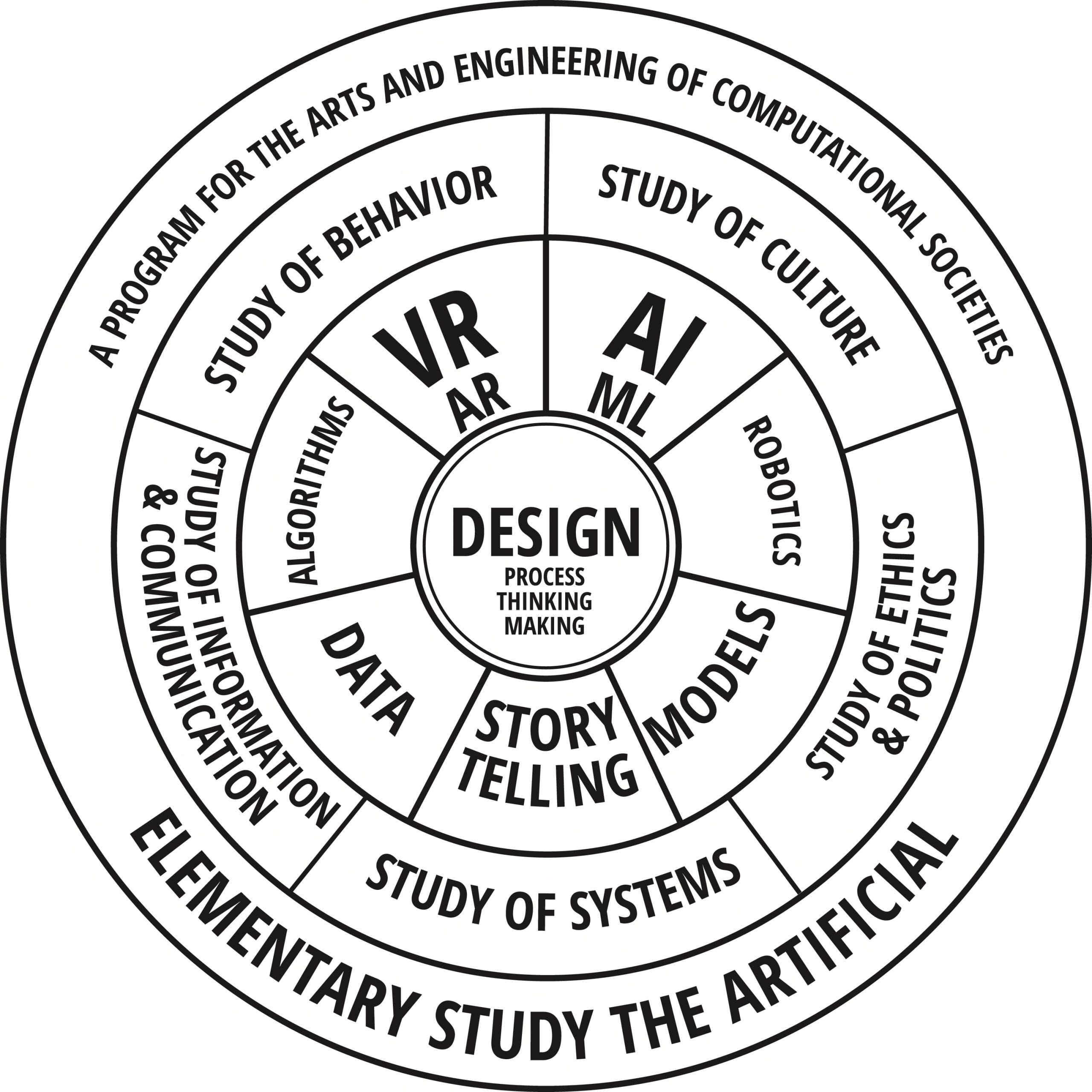
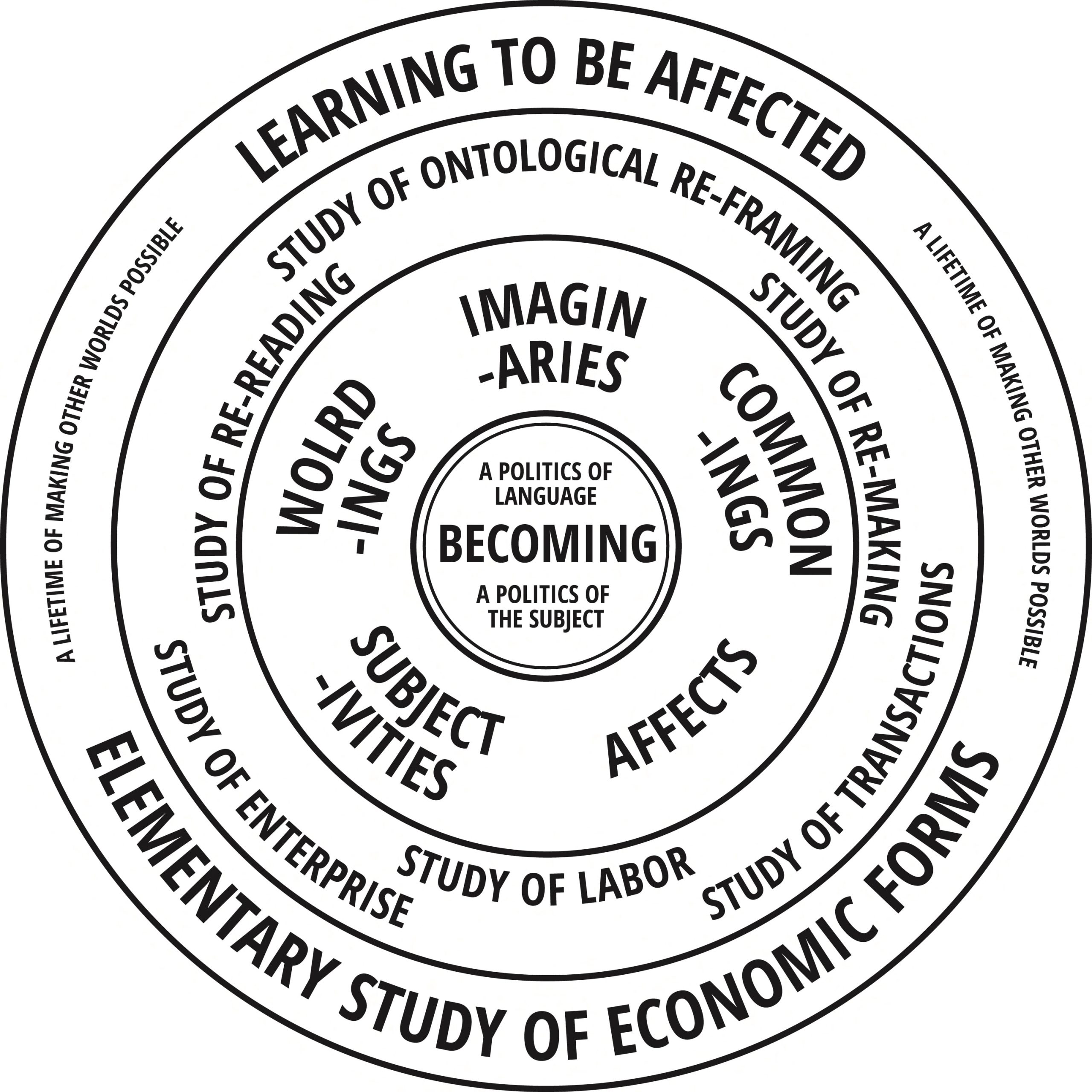
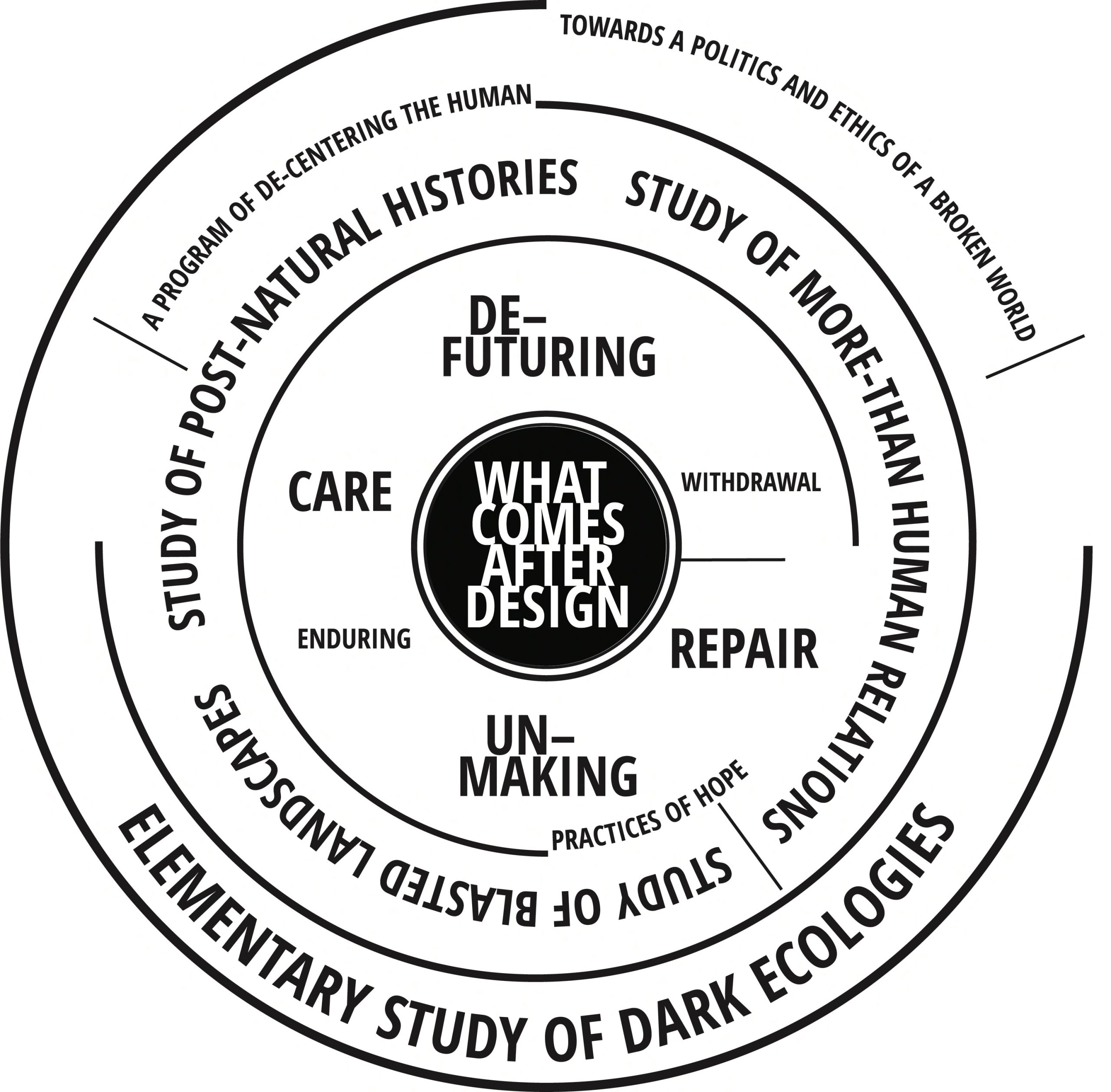
DiSalvo (2019) on imagined Bauhaus futures. Three speculative and possible versions of how the Bauhaus legacy can be performed. With permission by the author.

One of the curricula for Bauhaus Dessau. Photo: Åsa Ståhl.
The teaching team asked the students to reflect on how they understand our Design + Change-education, in comparison with other educations. Sharing was carried out in groups and in an online document. Exchange students who had joined us for the semester helped in broadening the view and examples. These activities stirred up some impatience with implicit questions such as why are we not working on our design skills? However, as a teaching team we wanted to set time aside to surface the expectations and imaginaries of education as a way to learn from and with the students on where they feel at home when comparing their education with other educations.
Chosen pedagogical assemblages for change agency
The course material is an immediate way set a tone for the joint semester-work. In this case it was to indicate both modesty and bravery (Arao and Clemens 2013). In addition to the two images below of foraging and the moon, the course Design+Change and the assignment fair share of domestic surplus was also introduced with a quote by the feminist author Ursula K. Le Guin.
”… we have not heard about the thing to put things in, the container for the thing contained. That is a new story. That is news.
And yet old. Before – once you think about it, surely long before – the weapon, a late, luxurious, superfluous tool; long before the useful knife and ax; right along with the indispensable whacker, grinder, and digger – for what’s the use of digging up a lot of potatoes if you have nothing to lug the ones you can’t eat home in – with or before the tool that forces energy outward, we made the tool that brings energy home. It makes sense to me. I am an adherent of what Fisher calls the Carrier Bag Theory of human evolution.” (Le Guin, 1988)

Tool to forage blueberries more efficiently. Photo: Åsa Ståhl.
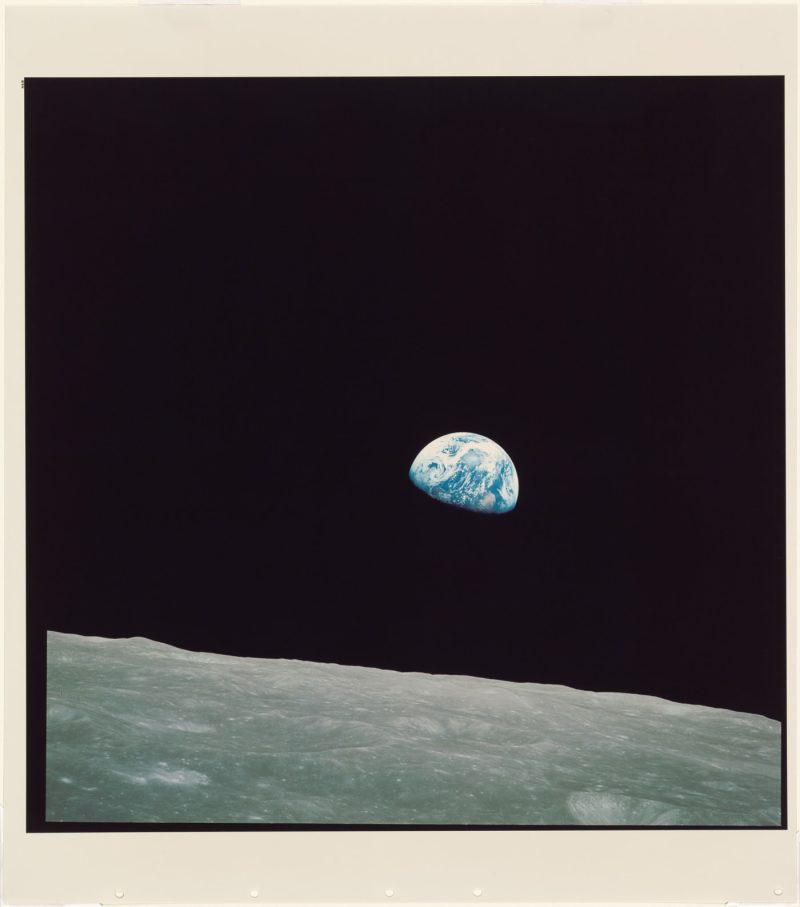
Iconic picture Earthrise by William Anders, taken in 1968 on Christmas Eve from the astronaut perspective on Apollo 8. Image credit: NASA. Public domain.
It is a pedagogical choice in a design education to put together this imaginary assemblage: on the one hand: an old, patented berry picking device that has been passed on in generations for foraging and introducing the international students to the The Swedish Right of public access; and on the other hand: get perspectives through the iconic Earth rise image from 1968 taken from the Apollo 8 mission and combine it with a quote from a novelist who rewrites imaginaries and narratives. The assemblage is also inspired by education for sustainable development, for example following Leichenko and O’Brien (2020): “The personal sphere of transformation is where students can explore how beliefs, values and worldviews – including their own – influence how they relate to climate change and how they engage with solutions and actions in political and practical spheres” (Leichenko and O’Brien 2020, p. 3). Taken together, these entry points guide the pedagogy towards not only change somewhere else, somewhere big, but also in the everyday and nearby.
Ecoliteracy to understand complexities
Design necessarily interfaces with different ways of knowing and making the world. Different disciplinary emphasis contributes to how to assess the processes and outcomes of our work.
When design is figured in an overlap with engineering, it often means to solve problems through technologies that aim to make life easier for (what often turns out to be some) humans. I think of this as a reformist agenda, for example trying to improve efficiency of electricity use for a green transition (but less often with a focus on diminishing electricity use). This comes across as a slow change within the paradigm of business as usual. In that sense it sits rather comfortably within the current dominant economy and does not challenge the underlying or overarching values and worldviews of how humans go about with resource distribution. Indeed, design was brought into being in an overlap with a particular kind of industry (Dilnot 2015) and has in many ways been developed to serve it.
Design is also often figured in an overlap with arts and crafts. This can be understood as a predominantly materially based version of design. Through critical theories on for example gender, decolonization, and posthumanism, design can be figured in yet other ways – and has a clear affinity and learning-curves together with humanities and social sciences. More rarely do we see design in an overlap with biology or ecology, although designers work in ecosystems of materials and conceptualisations.
In the change-semester the image of foraging blueberries points towards a close-encounter between providing for the livelihood of a multispecies community and materials used in local practices over time. Students share their engagements with different locations and sites. We also share worries and hopes and references across the student cohort and teaching teams to develop a literacy that goes beyond texts into ecological literacy (see for example Boehnert 2018). The effects of this teaching can be seen in many BA-thesis, for example in the one with the indicative title “Bee Me and the rest of Nature: Reflecting on our actions through holistically sustainable beehotels engraved with mental strengthealing journaling tools (Amber Gons 2023).
Mapping
The autumn semester 2022 included learning sessions on mapping “what is” and “what was” in terms of socio-cultural, economic, and ecological resources in various domestic spheres to imagine how things could be otherwise (on designing otherwise, see for example DiSalvo 2022). We connect products with systems and worldviews, using criticality as well as creativity to imagine “what if” over time.

This is a model that guides the Design + Change-education at the Department of Design at Linnaeus University. It is based on a metadesign approach and is communicated to staff and students in a booklet called Academy Culture.
The students are introduced right at the start of their programme in year 1 to the model of nested spheres. In the change-semester we use it to relate the mapping of complex relationships in fair share of domestic surplus. Mapping is conveyed as one of many ways designers aiming to contribute to change can go about with analysis and synthesis, observing and envisioning. At its best we are expanding the social imaginaries beyond the dominant narratives of future-making. In the teaching, there is a focus on trying to know one’s surrounding through different ways of sensing – no matter whether they are one’s own nearest domestic sphere or not, since entanglements are always present.
I let the cover for the electrical socket act as a reminder of interconnectedness with various actors, materials and conceptualisations. In the classroom, we shrink and expand on the perspectives on staying with the troubles of multispecies co-living. We build on others and various sources. The mapping of resources also involves getting to know the design field one is working in. We’re not alone in our work – others have gone before us and walk with us. So, the sessions have over the years involved visiting designers in a residency-collaboration and design researchers involved in research as well as digital field visits recorded by engaged designers on their own locations across the globe. The research project Reimagining Living with Others also hosts a collection of field visits that I have been part of commissioning from external collaborators in the public sector – to be seen here: https://livingwithothers.org/field-visits/
Sharing the work of those who have gone before us internally with the students is equally important to sharing externally. So, circulation has also been done through for example the design conference Attending to Futures. A film with digital synchronous meetings between students and international designers can be seen here: https://attendingtofutures.de/challenge
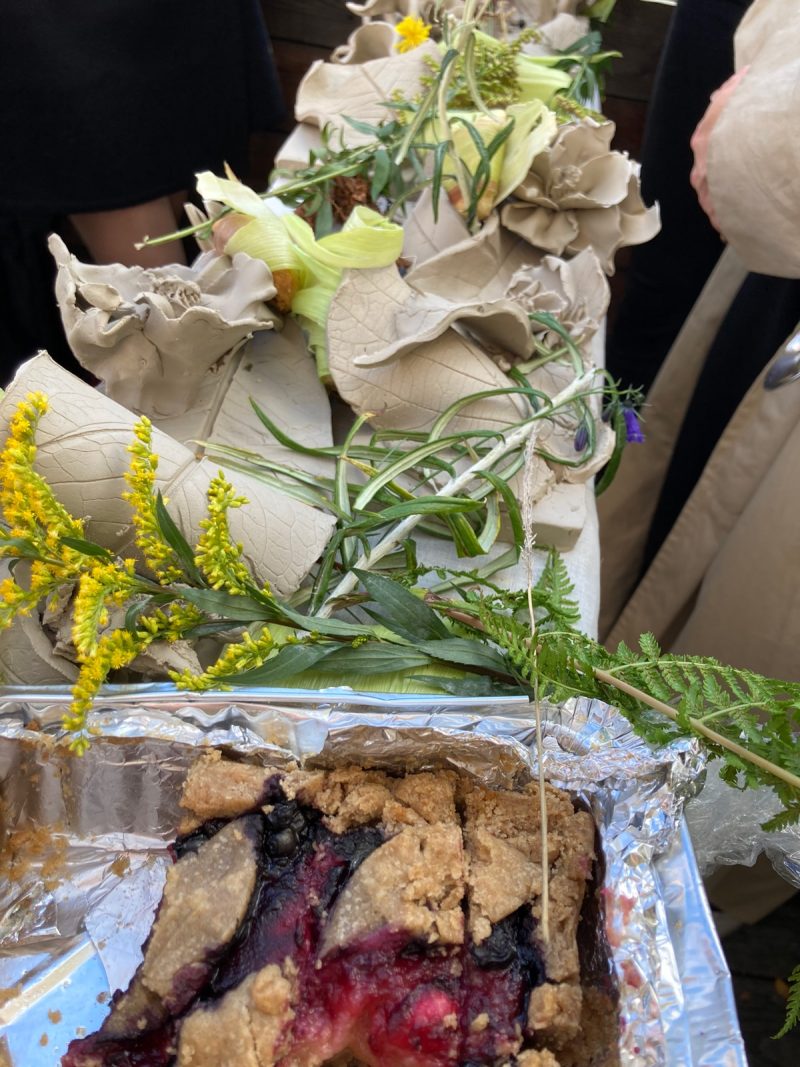
During the autumn 2022 the students met with the British duo Studio HOTmess. The duo were artists in residence with our department in a collaboration with IASPIS, the international section of the Swedish Arts Grants Committee, and the British council with a focus on circular cultures. Studio HOTmess invited the students to have a sensorial session in a bird watching tower, just 5 minute’s walk from the classroom. Photo: Åsa Ståhl
Perspectivising change
We can zoom out even further from the interconnectedness pictured in the classroom: As planetary beings we are losing biodiversity. Climate change is for real. Some are worse hit already than others. In a classroom with international intake, it means that we have different frameworks to work with that hold back or help imaginative questions and answers (see for example Savransky and Lundy 2022). In collaborations amongst students and with external partners perspectives can be negotiated, challenged, complemented. Handling non-articulated and non-aligning positions is a skill students might not have imagined that they would work with (see for example Gottlieb and Eriksson 2019). However, to gain experience of complex situations and to be able to design with humans and more-than-humans the negotiations of difference seems to be something to practice in educations.
The Earthrise picture showed planet Earth in a way that was interpreted as a vulnerable premise of life. Seen at such a distance, the borders that make up daily life were not visible, and it opened for imagining co-living differently. The image became part of a public language used in connection to ecological and environmentalist issues (Engfeldt 2022). Only one Earth, became the motto of the 1972 first United Nations Conference on the Human Environment that was taking place in Stockholm, Sweden. The idea at the UN-conference was to move from national answers to international collaboration since pollution did not stop at political borders. Focus was on ecological sustainability with a recognition of interconnectedness across the globe.
At the same time in the Scandinavian geographic area, the 1970’s, a particular version of participatory design started to emerge. There was a focus on involving users at work places in technological development and design that would affect the working life. This could be understood as social sustainability, without explicitly addressing ecological sustainability.
The Brundtland report, published by the UN in 1987, on sustainable development did aim to integrate ecological sustainability with social and economic ditto. This is captured in the much-traveled quote: “Sustainable development is development that meets the needs of the present without compromising the ability of future generations to meet their own needs.”
Different versions of sustainability are and have thus been high on the global Western agenda during the past decades. Also, what to sustain are changing, paradoxically. When we are trying to understand what versions of design and designing is on par with broken world thinking (Jackson 2014) it is important to remember that, for example, participatory design has a long history of working with what we now would perhaps call social sustainability. And in Sweden there is also a legacy of design working actively with ecological issues (see for example Fallan et al 2022, Larsson Heidenblad 2021). However, the integration of the eco-social has not always been as explicit as the current situation demands from us.
None can change everything on their own, but if we direct our energy towards both the emergent and emergencies, we are all able to contribute through our everyday lives in the university and beyond. According to Wamsler (2020) we need both internal and external transition. For designers, that could mean a conceptual move from efficiency to sufficiency (Callmer and Bradley 2021).
We as design students and researchers are recognising what took us here and what was good about it. We are also suggesting how to turn away from that which is obviously detrimental to humans and more-than-humans. It probably means an act of un/making (Lindström and Ståhl 2019; 2020 Jönsson, Lindström and Ståhl 2021; Laurien et al 2022) and perhaps even ungrading (Blum 2020) where we articulate evaluation indicators of wellbeing and sufficiency rather than growth, the new and high combustion. This might include keeping at it, composing success criteria that are helpful for not only the so-called resource man (Strengers 2014). It might involve composting certain incentives and emphasise self-assessment. Unlearning seems to be required in this navigating in-between current and more helpful norms and values in relation to resource distribution. Perhaps the aesthetics of these endeavors will be one of failures rather than ideas in line with slick Scandinavian design legacy or ideas of digitally, electrically connected, and smart homes. What preparedness do we have of expecting and accepting that which is uncertain, far from perfect, miscommunication, mishaps and alike in both internal and external collaborations, transitions and change work?
Drawing things together for wellbeing
I have not pointed out one thing that needs to be repaired, healed, cared for, or maintained. An international cohort of design students and teachers know from experience that there cannot be one answer to “what is” and “what if”. But as design educators and designers we do have agency. It is most strongly felt in the everyday life. For example, we can choose many of our references. We can choose pictures that guide us into repair, care, and maintenance practices. We can also respond to the messy assemblages that we come upon, those that we did not choose, but that are part of our daily lives in the classroom and beyond. In both cases it seems to be a matter of creatively and critically connecting concepts with materialities and contexts. As a way of conceptualising what is possible and preferrable we might have to practice more of subtracting than adding in order to live well together through broadened eco-social imaginaries. To strengthen design agency amongst our students we might best prepare them by applying a broken world thinking – and practice everyday, mundane hope of collaborative work that enables a movement between berry foraging in nearby forests and perspectives granted by space travel. In addition, it is helpful if we recognize that we are situated in, for example, shared educational structures that can be changed over time.
Acknowledgements
Thank you everyone who contributed to making these words and images become articulated! I’ve learnt with students and colleagues in teaching and elsewhere, and more particularly these reflections build on work done in the Formas grant with registration number 2020-02450.
List of references
Adams, G.S., Converse, B.A., Hales, A.H. et al. (2021). People systematically overlook subtractive changes. Nature 592, 258–261. https://doi.org/10.1038/s41586-021-03380-y
Arao, Briand and Clemens, Kristi. (2013). “From Safe Spaces to Brave Spaces. A New Way to Frame Dialogue Around Diversity and Social Justice”. In (Ed.) L. M. Landreman The Art of Effective Facilitation. Reflections from Social Justice Educators. Routledge. https://doi.org/10.4324/9781003447580
Blum, Susan, D. (2020). Ungrading. Why Rating Students Undermines Learning (and What to Do Instead). West Virginia University Press.
Boehnert, Joanna. (2018). ”Anthropocene Economics and Design: Heterodox Economics for Design Transitions”, She Ji: The Journal of Design, Economics, and Innovation, 4.
Borger, Julian. (2022). “’Grave concern’ as Ukraine Zaporizhzhia nuclear power plant under Russian orders. The Guardian [news article]. Retrieved 21 Jan 2024: https://www.theguardian.com/world/2022/mar/06/ukraine-zaporizhzhia-nuclear-plant-staff-under-russian-orders.
Braun, Noemi Jurina. (2022). ”Timefullness: an exploration of timeless fashion in the context of sustainability”. [BA-thesis in design] https://urn.kb.se/resolve?urn=urn:nbn:se:lnu:diva-113310
Briland, Julian. (2018). ”Dissecting as a Method in Micro-Utopianism”. [BA-thesis in design] https://urn.kb.se/resolve?urn=urn:nbn:se:lnu:diva-77027
Callmer, Åsa, and Bradley, Karin. (2021). “In search of sufficiency politics: the case of Sweden”, Sustainability: Science, Practice and Policy, 17(1): 195-209. DOI: 10.1080/15487733.2021.1926684
Czekajska, Wiktoria. (2021). Co-neighbouring: when residents become designers of their neigbourhoods”. [BA-thesis in design] https://urn.kb.se/resolve?urn=urn:nbn:se:lnu:diva-105705
Dilnot, Clive. (2015). “History, Design, Futures: Contending with what we have made”, in (Eds.) T. Fry., C. Dilnot & S. Stewart, Design and the Question of History. London/New York, Bloomsbury.
DiSalvo, Carl. (2019). “Diagrams for Another Bauhaus.” (Eds.) L. Forlano, M. Wright Steenson, & M.Ananny. Bauhaus Futures. MIT Press, 77-82.
DiSalvo, Carl. (2022). Design as Democratic Inquiry. MIT Press. https://direct.mit.edu/books/oa-monograph/5261/chapter/3573847/Introduction
Engefeldt, Lars-Göran. (2022). ”Framgångsfaktorer och svårigheter för att nå helheter och undvika stuprör”. Kungl. Skogs- och Lantbruksakademiens tidskrift, 9-14. https://www.ksla.se/wp-content/uploads/2022/03/KSLAT-1-2022-Stockholmskonferensen-50-ar.pdf
Fahd, Ahmad and George Bsirini. (2021). “Syrians of the Diaspora: Seeding and harvesting the design of a book and a manifesto”. [BA-thesis in design]. https://urn.kb.se/resolve?urn=urn:nbn:se:lnu:diva-105450
Fallan, Kjetil., Zetterlund, Christina and Munch, Anders V. (eds.) (2022). Nordic Design Cultures in Transformation, 1960-1980: Revolt and Resilience. Routledge. https://doi.org/10.4324/9781003309321
Fähndrich, Laura. (2020). “Tasting Bubbling Naturecultures and Touching M/other’s Hands: Aesthesias of Microbial Touch Points”. [BA-thesis in design] https://urn.kb.se/resolve?urn=urn:nbn:se:lnu:diva-96975
Gibson-Graham, J-K. and Miller E. (2015). “Economy as ecological livelihood”. In (Eds.) K. Gibson, D. Bird Rose & R. Fincher, Manifesto for Living in the Anthropocene. Punctum Books. https://punctumbooks.com/titles/manifesto-for-living-in-the-anthropocene/
Gons, Cornelie Amber (2023). “Bee Me and the rest of Nature. Reflecting on our actions through holistically sustainable beehotels engraved with mental strengthealing journal tools.” [BA-thesis in design] https://www.diva-portal.org/smash/get/diva2:1763524/FULLTEXT01.pdf
Gottlieb, Laura and Eriksson, Yvonne. (2019). ‘Students’ Comprehension of Design Collaborations with External Organizations’, in Proceedings of the 22nd International Conference on Engineering Design (ICED19), Delft, The
Netherlands, 5-8 August 2019. DOI:10.1017/dsi.2019.62
Haldrup, M., Samson, K., & Laurien, T. (2022). ”Designing for Multispecies Commons”. In PDC 2022 Vol. 2: Proceedings of the Participatory Design Conference 2022. https://dl.acm.org/doi/10.1145/3537797.3537801.
Hallgrímsdóttir, Una. (2022). “Comfort Food – Comfortable for Who?: An Exploration of Genuine Comfort Food Through Design”. [BA-thesis in design] https://urn.kb.se/resolve?urn=urn:nbn:se:lnu:diva-96975
IEA. (2022). “Energy saving actions by EU citizens could save enough oil to fill 120 super tankers and enough natural gas to heat 20 million homes. [press release 21 April 2022]. Retrieved from: https://www.iea.org/news/energy-saving-actions-by-eu-citizens-could-save-enough-oil-to-fill-120-super-tankers-and-enough-natural-gas-to-heat-20-million-homes
Ireland, Leah. (2019). “Weaving Futures, Feminisms in Practice”. [BA thesis in design] https://www.diva-portal.org/smash/get/diva2:1335519/FULLTEXT02.pdf
Jackson, Stephen. (2014). “Rethinking Repair”, in Tarleton Gillespie, Pablo J. Boczkowski, och Kirsten A. Foot (eds.), Media Technologies: Essays on Communication, Materiality and Society, 221–40. Cambridge, MA: MIT Press. Retrieved from: https://doi.org/10.7551/mitpress/9780262525374.003.0011
Jackson, Stephen. (2023). “Ordinary hope”. In Maddalena Taccheti, Dimitris Papadopoulos, and Maria Puig de la Bellacasa, (eds). Ecological Reparation: Repair, Remediation, and Resurgence in Social and Environmental Conflict. Bristol: Bristol University Press.
Jönsson, Li., Lindström, Kristina and Ståhl, Åsa. (2021). ”The thickening of futures”, Futures, 134. https://doi.org/10.1016/j.futures.2021.102850
Larsson Heidenblad, David. (2021). Den gröna vändningen. En ny kunskapshistoria om miljöfrågornas genombrott under efterkrigstiden. Lund: Nordic Academic Press. https://doi.org/10.21525/kriterium.28
Laurien, Thomas., Jönsson, Li., Lilja, Petra., Lindström, Kristina., Sandelin, Erik. & Ståhl, Åsa. (2022) “An Emerging Posthumanist Design Landscape”. In (Eds.) T. Herbrechter et al Palgrave Handbook of Critical Posthumanism. Palgrave. https://doi.org/10.1007/978-3-030-42681-1_42-2
Leichenko, Robin and O’Brien, Karen (2020). ”Teaching climate change in the Anthropocene: An integrative approach”, Anthropocene, Volume 30. https://doi.org/10.1016/j.ancene.2020.100241.
Lindström, Kristina and Ståhl, Åsa. (2019). ”Caring Design Experiments in the Aftermath”, Proceedings of the 8th Bi-Annual Nordic Design Research Society Conference 2019, nr 8, 2019. https://archive.nordes.org/index.php/n13/article/view/495
Lindström, Kristina and Ståhl, Åsa. (2020). ”Un/Making in the Aftermath of Design”, Proceedings of the 16th Participatory Design Conference, 12-21. https://doi.org/10.1145/3385010.3385012
O’Brien, K., Carmona, R., Gram-Hanssen, I. et al. (2023). “Fractal approaches to scaling transformations to sustainability”. Ambio 52, 1448–1461. https://doi.org/10.1007/s13280-023-01873-w
Ratzinger, Sofia. (2018). “Cultivating Collaborative Lifestyles in Urban Neighbourhoods”. [BA-thesis in design]. https://urn.kb.se/resolve?urn=urn:nbn:se:lnu:diva-75295
Savransky, Martin. & Lundy, Craig. (2022). “After Progress”, Sociological Review 70:2.Shen, Xiaoyi. (2020). “Encounter Border Creatures in Human Fabrications: The becoming of human on a corona para-site. [BA-thesis in design] https://urn.kb.se/resolve?urn=urn:nbn:se:lnu:diva-96917
Shove, Elizabeth. (2012). “The shadowy side of innovation: unmaking and sustainability.” Technology Analysis & Strategic Management 24(4), 363-375. https://doi.org/10.1080/09537325.2012.663961
Stoddard, Isak., Anderson, Kevin., Capstick, Stuart et al. (2021). “Three Decades of Climate Mitigation: Why Haven’t We Bent the Global Emissions Curve?”. Annual Review of Environment and Resources. 46(1), 653-689. https://doi.org/10.1146/annurev-environ-012220-011104
Strengers, Yolande. (2014). “Smart Energy in Everyday Life: Are You Designing for Resource Man?”. Interactions, 24-31. https://interactions.acm.org/archive/view/july-august-2014/smart-energy-in-everyday-life-are-you-designing-for-resource-man
Ståhl, Åsa. (2023). ”Anchoring by Picking Stones – on Design and Economics in Småland and Other Places”. In (Eds.) A. Kuhmunen and C. Zetterlund. Småland & Sápmi. Sápmi & Småland: Design histories from different geographies. Växjö: Linnaeus university press. https://urn.kb.se/resolve?urn=urn:nbn:se:lnu:diva-126118
Ståhl, Åsa (2019). “Building and home making for permaculture”. In (Eds.) M. Tham, Å. Ståhl & S. Hyltén-Cavallius. Oikology – Home Ecologics: a book about building and home making for permaculture and for making our home together on Earth. Växjö: Linnaeus University Press. 78-111. https://urn.kb.se/resolve?urn=urn:nbn:se:lnu:diva-90036
Tham, Mathilda., Ståhl, Åsa. & Hyltén-Cavallius, Sara. (2019). Oikology – Home Ecologics: a book about building and home making for permaculture and for making our home together on Earth. Växjö: Linnaeus University Press. https://urn.kb.se/resolve?urn=urn:nbn:se:lnu:diva-90036
Thierry, Aaron., Horn, Laura., von Hellermann, Pauline & Gardner Charlie J. (2023). “No research on a dead planet”: preserving the socio-ecological conditions for academia”. Frontiers in Education 8. DOI=10.3389/feduc.2023.1237076
Tonkinwise, Cameron. (2019). ““I Prefer not to: ”Anti-Progressive Designing.” In Undesign: A Critical Practice at the Intersection of Art and Design. In (Eds.) G. Coombs, A.McNamara, and G. Sade. London: Routledge.74-84.
Wamsler, Christine. (2020). “Education for sustainability. Fostering a more conscious society and transformation towards sustainability”. International Journal of Sustainability in Higher Education, 21 (1), 112-130. DOI 10.1108/IJSHE-04-2019-0152
↑ Top