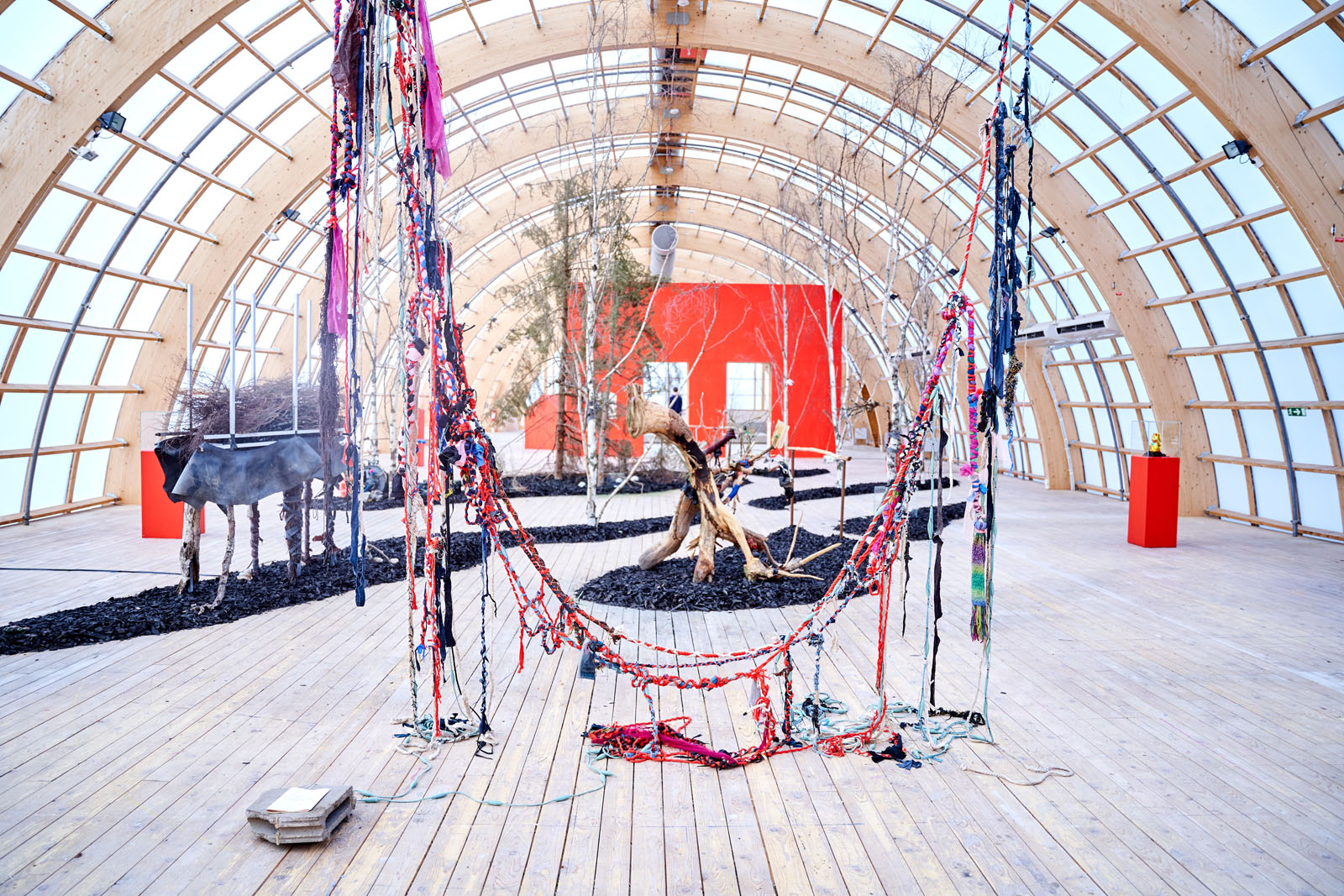
Troll perception in the Heartlands – artistic research to widen our imagination capacity
Dear fellow creatures,
This writing comes from a place of waste, wounds, and wonders. It spills out of a project called Troll perception in the Heartlands – artistic research to widen our imagination capacity. Our longing to join pack with +Change at LNU started many years ago when we met and started to get to know individual researchers and experienced student projects that came out of the program. When we (the art, design, and architecture collaboration MYCKET, Mariana Alves Silva, Katarina Bonnevier & Thérèse Kristiansson) realized that we needed to take the chafing of our inner changelings seriously (those inner voices that cannot stand the human destruction of the planet) and develop what we have come to call ‘TrollVision’. In 2019 we asked Åsa Ståhl, Mathilda Tamm and Christina Zetterlund if they wanted to roam with us, and yes! they agreed, by now our tails are tied together.
The pack has grown, in various periods we have joined pack with faculty and students at LNU and other creatures across the planet – so far more than six hundred humans, across a multitude of geographies, have joined us to scavenge and salvage our heartlands, with the help of mythology and unhuman creatures, our queer kinsfolk, the folkloristic troll. However, the chafing has turned into wrath. It is in our guts. Gnawling. It is in our chests. Around our collarbones, suffocating us. We can’t breathe anymore. Twenty years, that is what is left for humankind. A collective suicide pact, that’s what Antonio Guterres called it.[1] Unless we stop now and craft a global pack.
For the Collection of Change we re-enact a written performance; the manuscript to Trollmother’s Cradle – to underscore the necessity of crafting and cradling communities and the sites of belonging – the heartlands. The manuscript also entails the story of a d-i-g (doing in group) our artistic method of co-creation. To celebrate what we have come to cherish at +Change LNU.
With love from MYCKET; Mariana, Katarina & Thérèse
MANUSCRIPT: “The Cradle of the Mother Troll”
CAST OF CHARACTERS:
Thérèse (member of MYCKET)
Mariana (member of MYCKET)
Katarina (member of MYCKET)
Mother troll (the main character in Birgit Holmberg’s lullaby “Ho aj aj aj aj buff”)
Ursula (the author Ursula K Le Guin)
Ache (the philosopher Hélène Cixous)
Fellow travelers in the bus
Skord (the main character in the author Kerstin Ekman’s novel The Forest of Hours)
Trees (the living trees on planet Earth)
Robin (the mother, scientist, decorated professor, and enrolled member of the Citizen Potawatomi Nation Robin Wall Kimmerer)
Prologue:
This is ours (MYCKETs) manuscript for a d-i-g [doing in group] – our artistic method of co-creation. During this d-i-g, ‘The Cradle of the Mother Troll’ was completed in its current form. The cradle was created during a bus excursion, September 9, 2021, at the invitation of the art project “Forest Calling – A Never-ending Contaminated Collaboration or Dancing is a Form of Forest Knowledge” (Malin Arnell and Åsa Elzén) and Accelerator exhibition space at Stockholm University.
The d-i-g takes place as we roll from Accelerator towards the historic site of the Women’s Civic School at Fogelstad (1924–52). To prepare the d-i-g, we have assembled basic materials to start from. Before the journey, we have braided long tails (as long as the two buses) along which we have tied loose ropes, fibers and rags.
Preparing the two braided tails for “Ho aj aj aj aj buff” in a park on Lilla Essingen, Stockholm, Aug. 24, 2021.
TrollVision is the name of the youtube channel and the filmanimations created within the research project ‘Troll perception in the Heartlands – artistic research to widen our imagination capacity’.
When the bus has rolled out onto the highway and the fellow travellers have calmed down, we play the TrollVision soundtrack from the bus speakers. In the meantime, we untangle and put the long tail in the center aisle of the bus. From woven baskets, we offer some skeins to those who have settled down on the seats.
THÉRÈSE addressing the bus audience: A warm welcome dear listeners, participants, or, if you wish; troll pack!
MARIANA: Our names are Mariana Alves Silva, Katarina Bonnevier and Thérèse Kristiansson and together we form MYCKET – an art, design and architecture collaboration that this autumn conjured together for ten years. What you just heard was Sara Parkman’s & Hampus Norén’s “Mors Lilla Olle” which is the soundtrack to our research project “Troll perceptions in the Heartlands”.
KATARINA: It is morning here with us on this bus, but in the story we’re about to tell, we want to invite you to a twilight place where the little ones are already asleep. A place you may know, we call it heartland, where the mother troll has just put her eleven little trolls in bed and tied them together by their tails. Through Margit Holmberg’s popular lullaby “Ho aj aj aj aj buff”, the mother troll is one of the most present beings here in our contemporary geography of the troll folk who share our human-dominated regions. Troll folk such as vättar, sprites, vittror, waldfrau, rån, pan, stalos, demons, changelings, shapeshifters, and other skrymt.
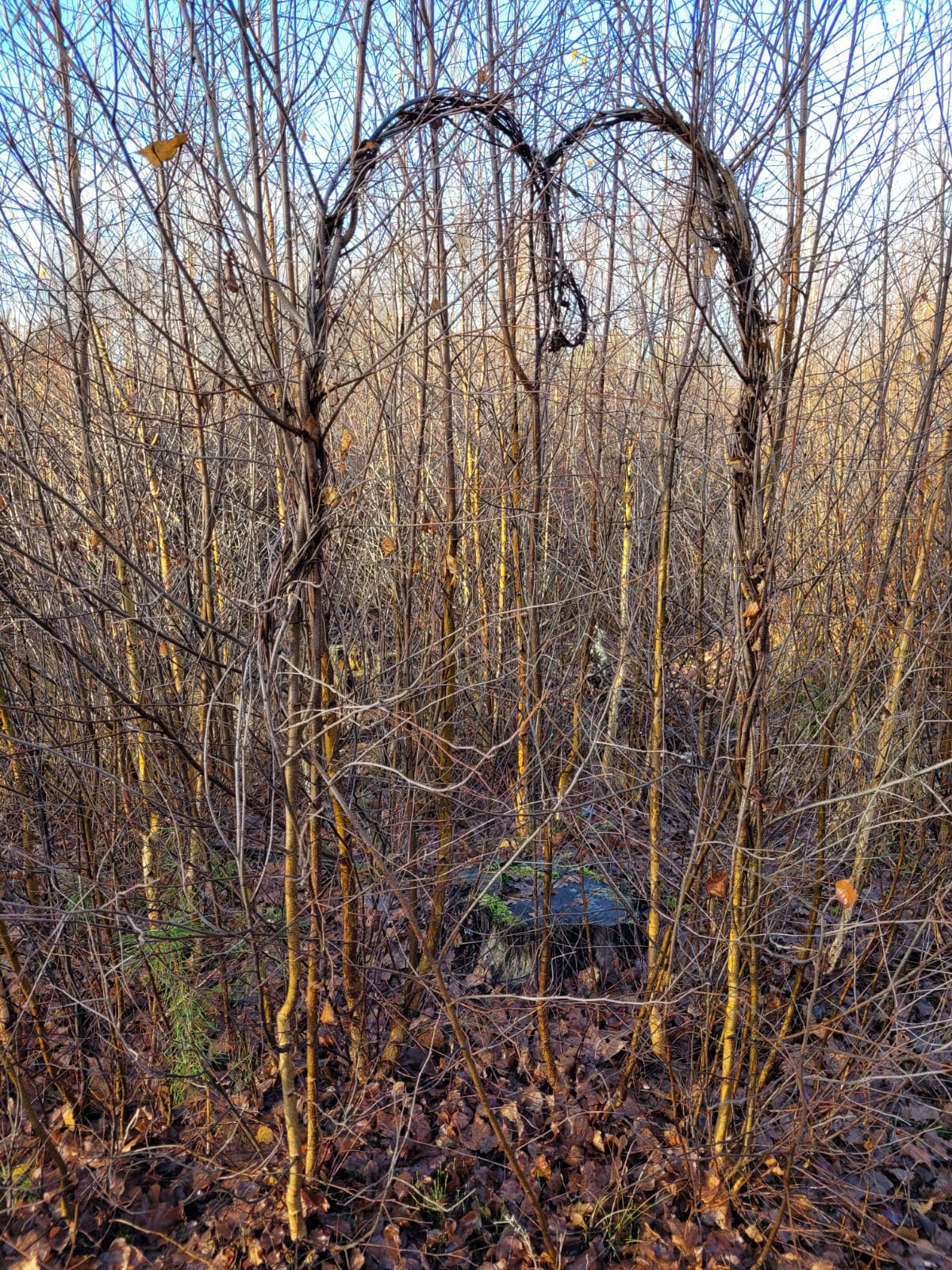

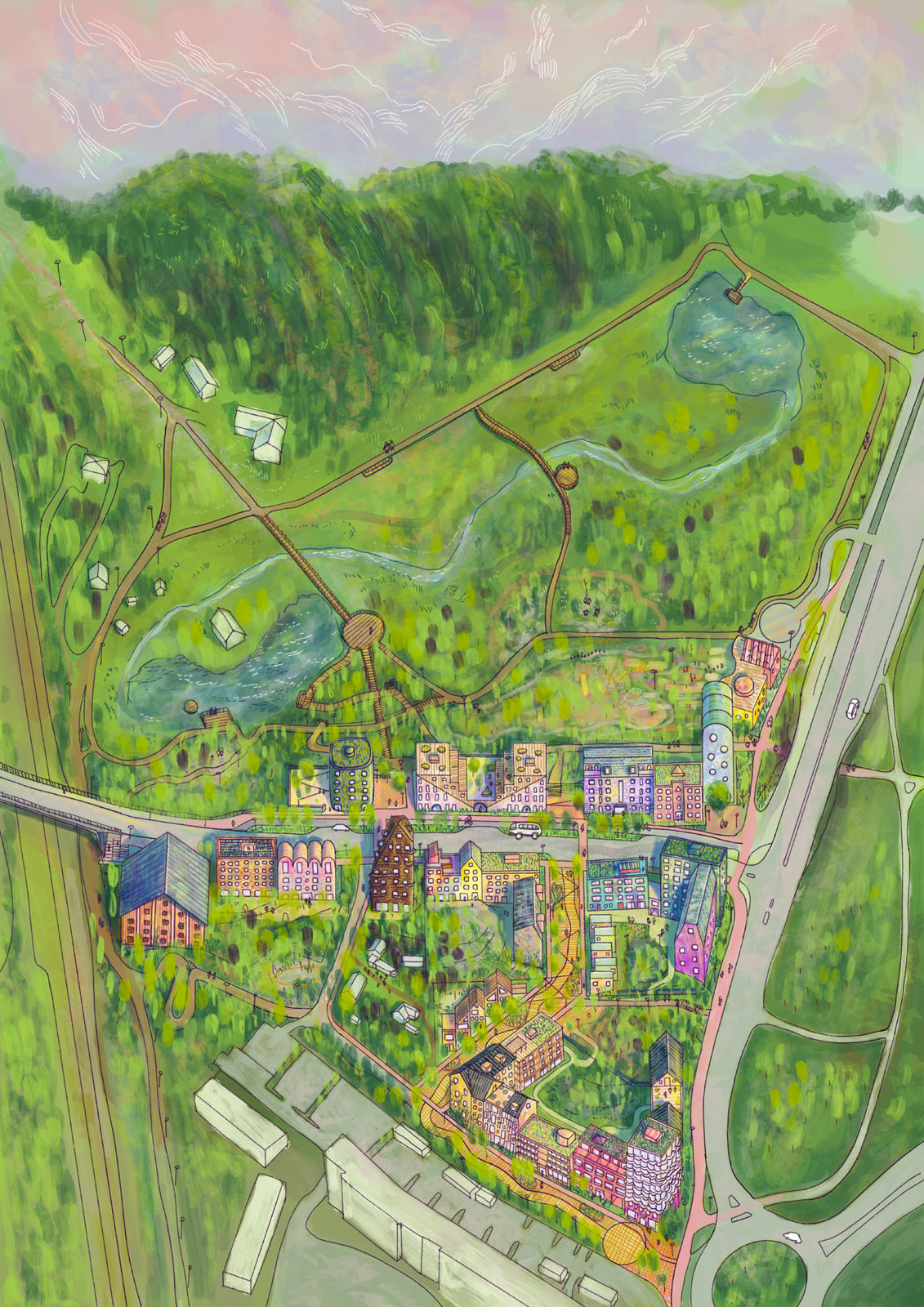
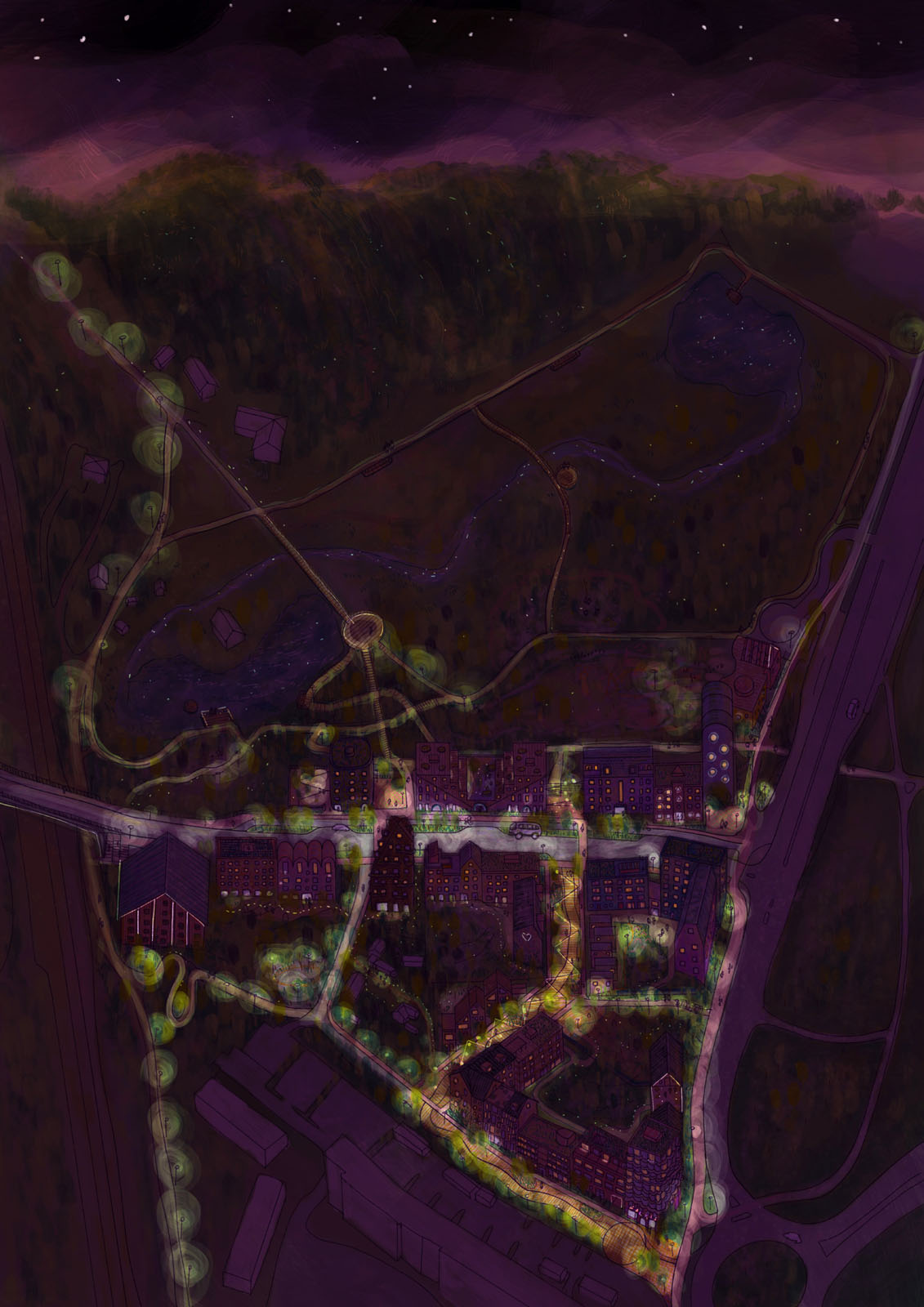
Our own personal heartland and the one we depart from in the research project lies in the Lesbian Valley and along the hiking trail Östgötaleden in Sankt Anna, Östergötland. Together with Magdalena Marano and Marie Carlsson from ‘Madam Carpentry & Restoration’ we’ve been tending to it during the years.
MARIANA: We don’t change ports; we are designers at the service of shape-shifters. On the other hand, all three of us have tried to hide, tame, and dampen the cries, the screeching, the force, and the chafing of our inner changelings. Those who tell us how the restless societal body we are part of is sucking out the earth and destroying our common future.
KATARINA: Now we want to listen, develop our troll perception and an animated grammar, move like packs along with our unhuman neighbours.
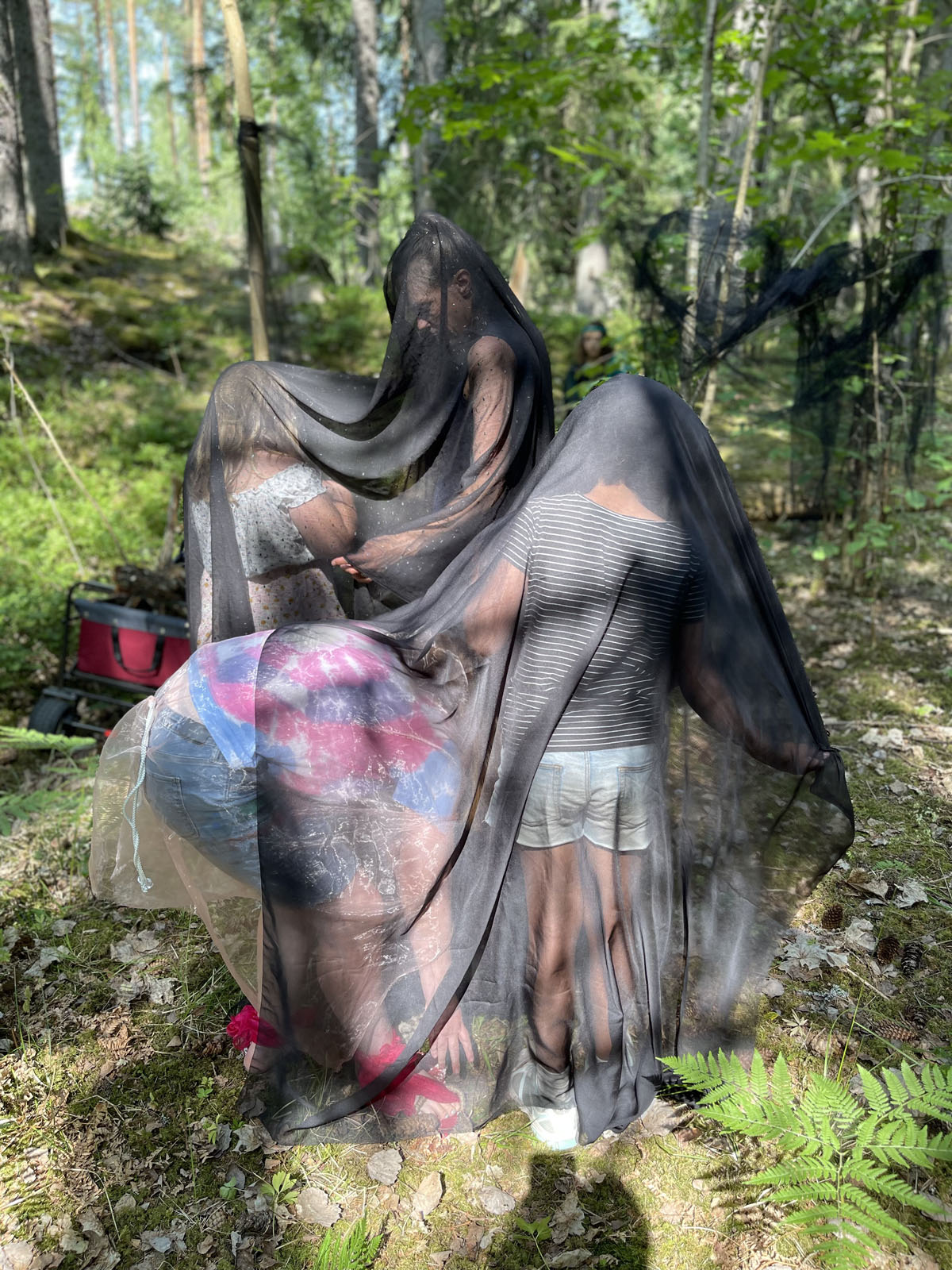
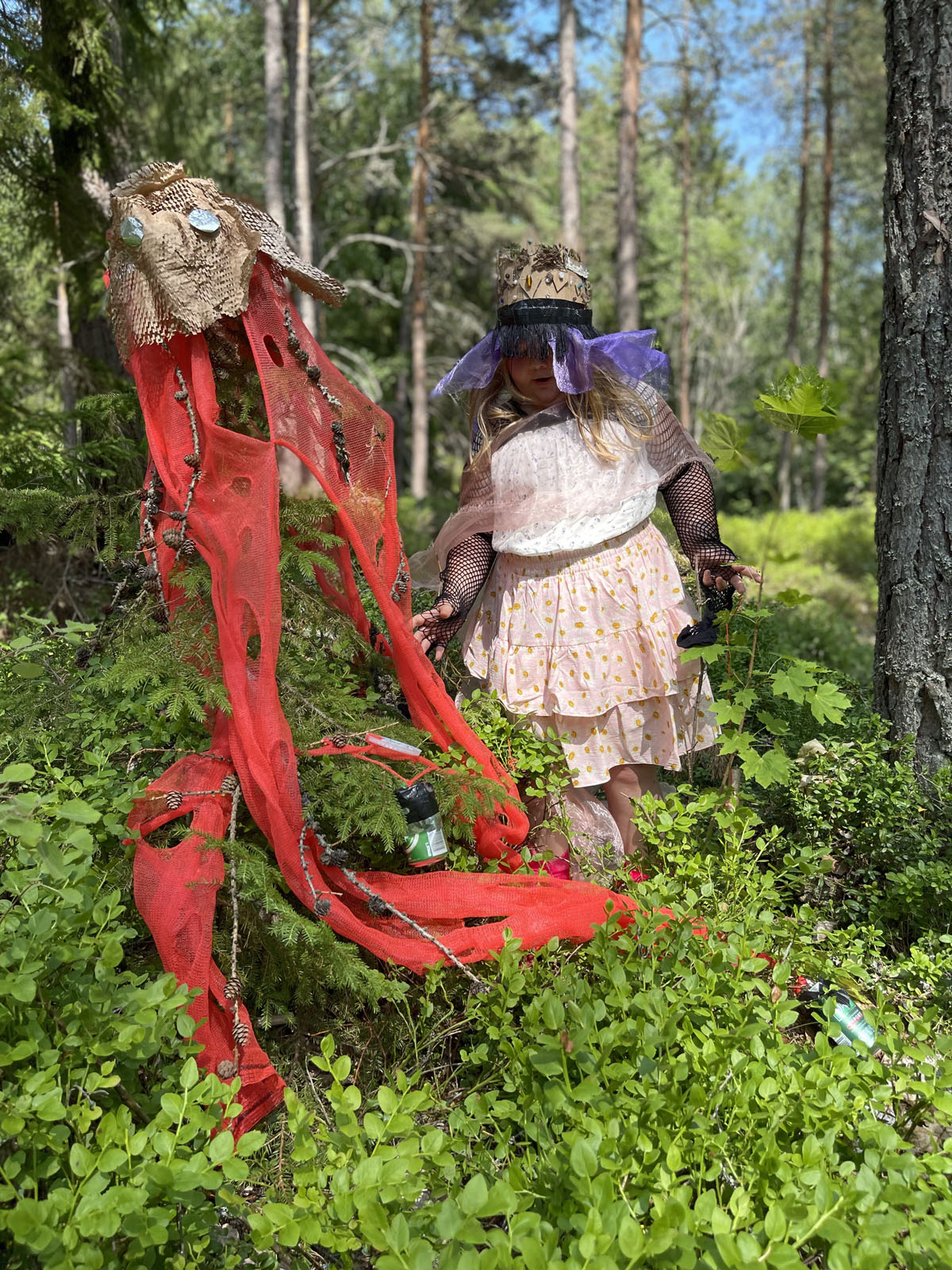

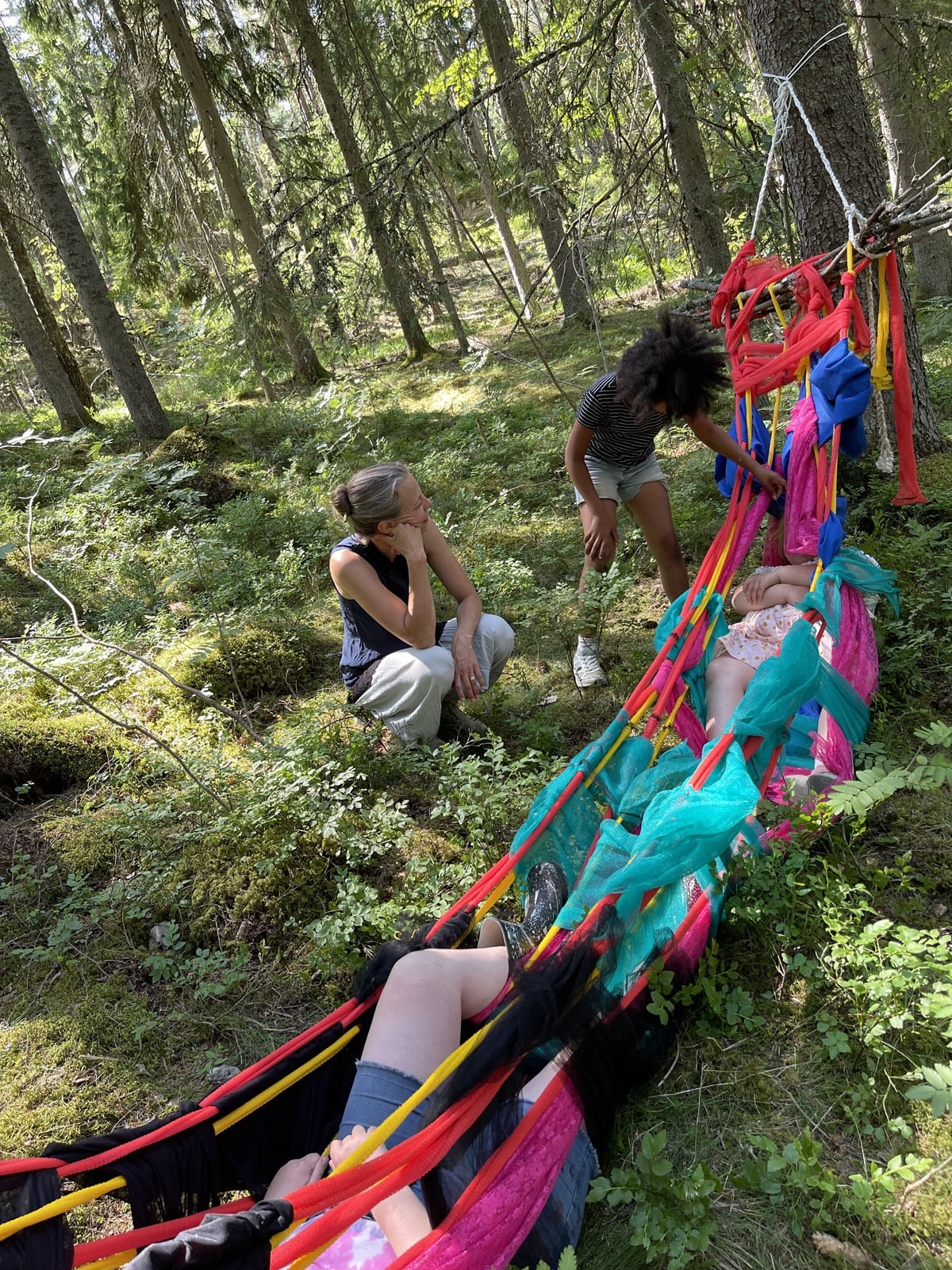
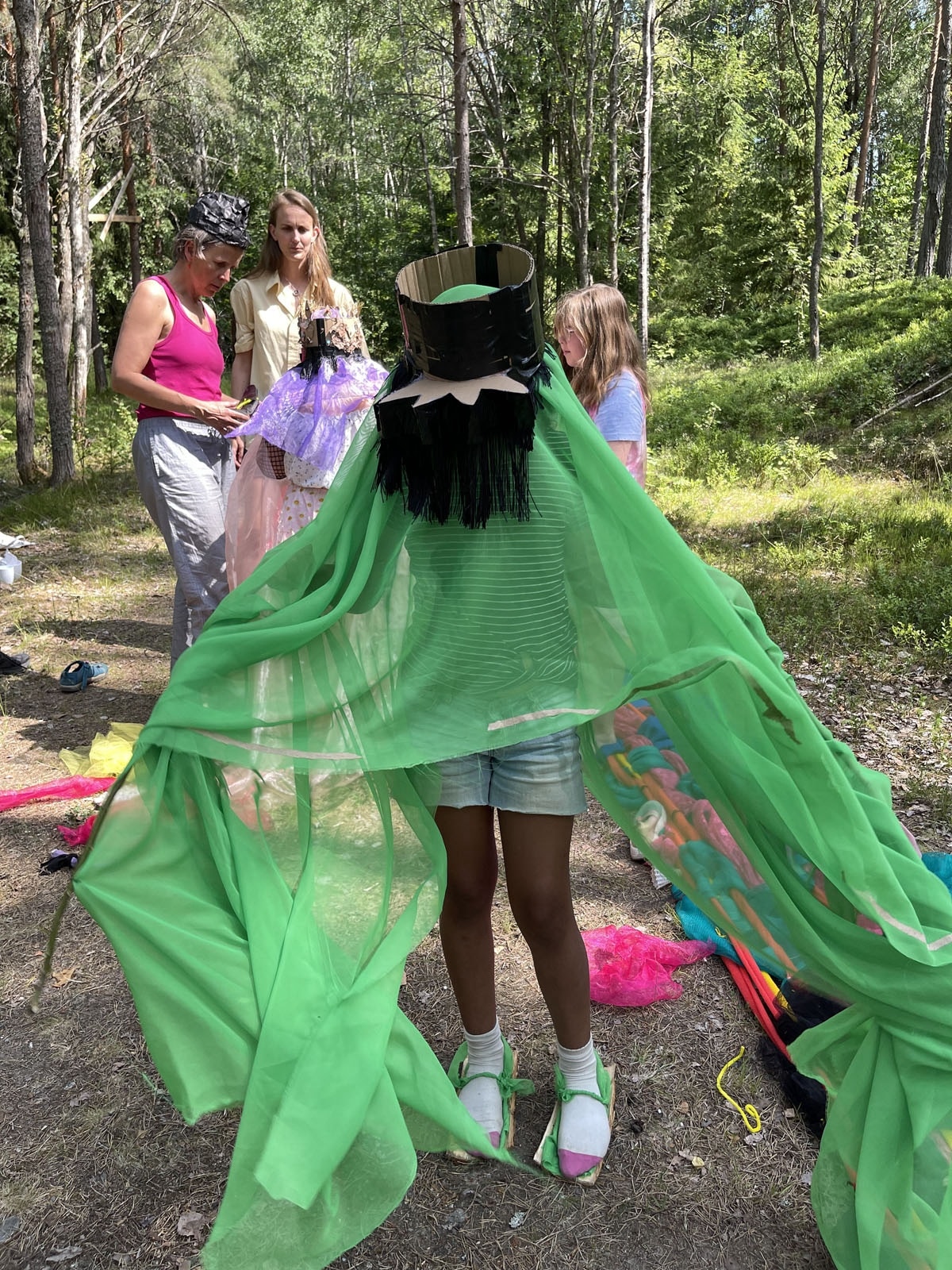
Joining pack with local young artists, ‘Shapeshifters’ at Rejmyre Art Lab summer school 2023. Creating a forest drag show together Octopus Queen, King Spruce, Maple Servant and Mourning Tree amongst others.
THÉRÈSE: With mother troll, and Margit, as teachers, our hands have begun to tie and braid an allegory for all our flawed tails that still bind us together[2]. If you want, you can just listen and watch, maybe touch the braid, if you want and can, your fingers can continue to braid the troll tail during the journey. Nobody needs to know how to braid, knot on knot means a lot. The braid has a stem but also many small tails that can be tied together.
MARIANA: Or take a loose skein, make a tangle of fibers and tuck into the play. As you want and are capable of during this swaying bus journey. For us personally, the contact with some kind of materiality, through doing, tinkering, kneading,chewing, sitting, walking, rocking, is what brings us closer to the stories, which makes us part of the living organism that is the world.
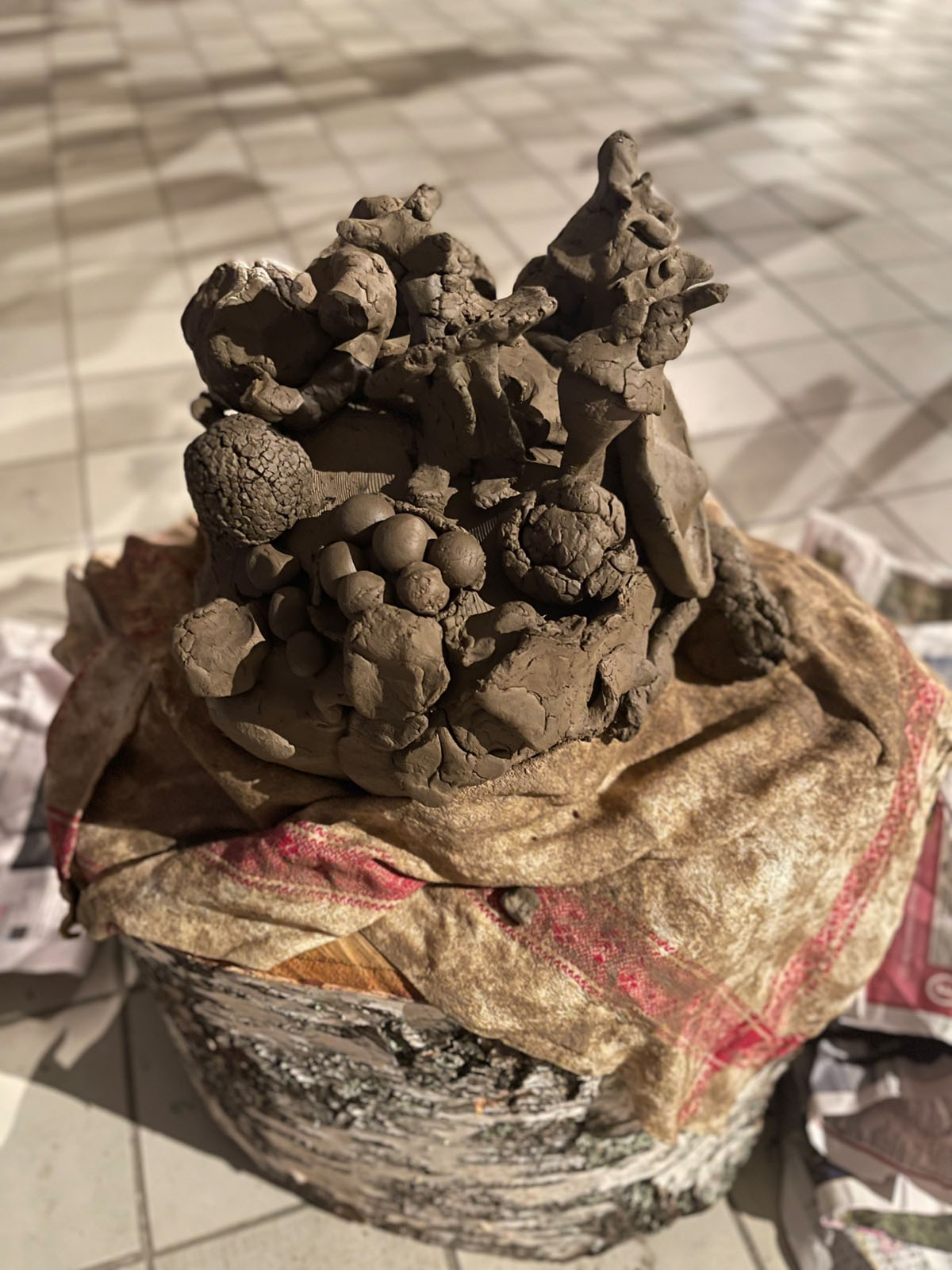
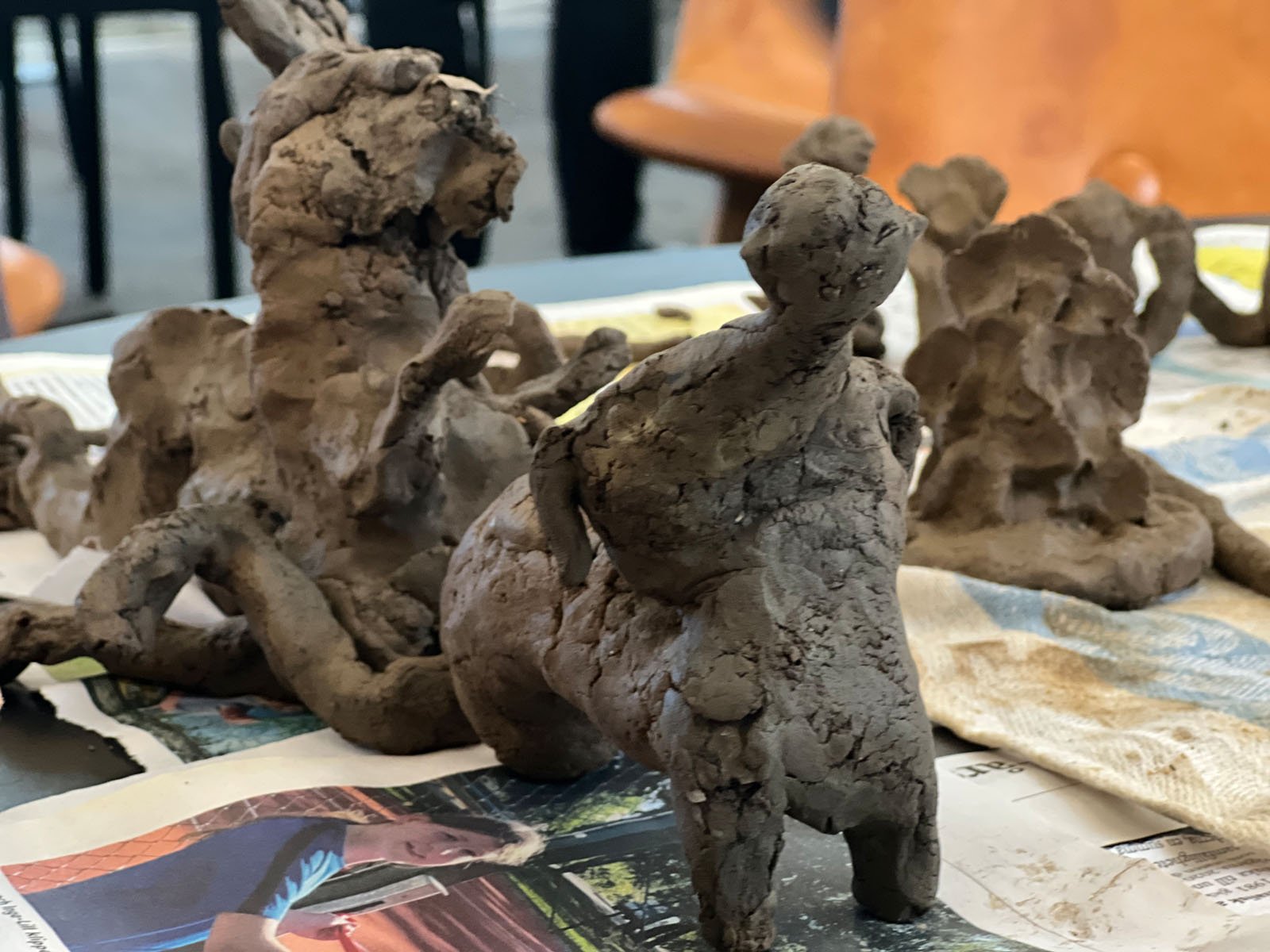
Another material we’ve been using to come closer to the stories of the world is clay. We found clay in the grounds of our heartland in the Lesbian Valley and have developed a method for kneading and imaging. Participants are invited to take a piece of clay and play with it during our lectures. Once the lecture is over, we mash each and everyone’s small creation into one big lump of clay again. And reuse the lump at the next lecture. Out of the love for clay, we’ve also established a community clay workshop, which we’ve built up with the generous help from Anders Nyhlén, ceramist and pedagogue from Söderköping.
The story begins:
In a forest slope next to a small reed-fringed lake, Trollmor sits in front of a fire. She is hard to distinguish from her surroundings in the violet twilight. Her appearance merges with the damp rock wall behind, the landfill pile of concrete, charred roots and rusted rebar, the tree trunks, and the yellowing grass all around. There are also some human beings sitting around the fire. Everything is reflected in the still lake, which the local people call Rödbraket. Hear how mother troll slowly sings the most beautiful words she knows:
MOTHER TROLL hums:
Ho aj aj aj aj buff,
ho aj aj aj aj buff,
ho aj aj aj aj buff buff!
Ho aj aj aj aj buff.
At each “buff” she gently pushes one of the mossy rocks lying on the ground next to her. The stones, which are her little ones, respond to the touch, settles in, and begin to hiss softly. Someone cries in their sleep. The people by the fire do not sleep; they poke at the glowing wood, chop vegetables and nuts, fry mushrooms in a murika. One speaks enthusiastically, maybe has a hard time hearing? Because the voice is a bit loud…
URSULA: Sure, it’s mammoth hunters occupying spectacular cave walls – because they created the most spectacular stories – but consider that what we humans actually did to keep ourselves fat and alive was to gather seeds, roots, sprouts, shoots, leaves, nuts, berries, fruits and grains. Laying nets and snares for birds, fish, rabbits, and other small animals to increase the protein[3].
MARIANA addressing the bus audience: You know, Ursula, she who speaks. She is a shapeshifter, her second port is as a bear. That’s probably why the voice is so rough and strong. Her human form carries the full name Ursula Kroeber Le Guin. Ok, back to the twilight by the fire:
URSULA: The collectors had like 15 hours work weeks to be able to live a good life.
One of the other figures by the fire…the one who can’t help chopping with the axe, feeding the fire with juniper shavings and spruce branches so that ash and fireflies crackle all over the lake. The fire likes her, they seem to have something in common. The ash draws thick lines around her eyes.
KATARINA whispering to the bus: We recognize her as H, “Ache” as Hélène Cixous.
ACHE: Oui, hello! Le pardis ce n’est pas perdu, we are only the ones who haven’t recovered it! And the reason is that we suffer from two vices, lazyness and impatience. As a result, we do nothing, we stop out of laziness and we run out of impatience. Paradise lies below[4].
URSULA: Just like that, the restless and impatient among the collectors went hunting, coming back with a lot of meat, a lot of ivory and a story. It wasn’t the meat that made the difference. It was the story. The story of the hero. Heroes are powerful. Before you know it, the men and women among the wild oats, their children, the entire creation story, and all the songs that are sung have been pressed into the service of the hero. But it is not their story. It is his.
[Silence]
MARIANA addressing the bus: How’s the tail coming along? Although this braided tangle is currently limited by the space of the bus, the fibers we weave carry stories of other places and other hands: plastic foil found in the planted forests in our heartlands in Östergötland; worn-out clothes beyond repair, worn by several generations of children; the turquoise rope with floats from the cleaning of the fisherman’s shed on Ven; plastic bags from the magical gorge between SÖS and Årstaviken; the red rope from the queer surrealist theater we made for the BoNuDå exhibition at ArkDes that was twined by the rope maker on Skeppsholmen; a torn jute rug (we will probably never know where the fibers have grown); an allergenic rag rug made of leather waste.
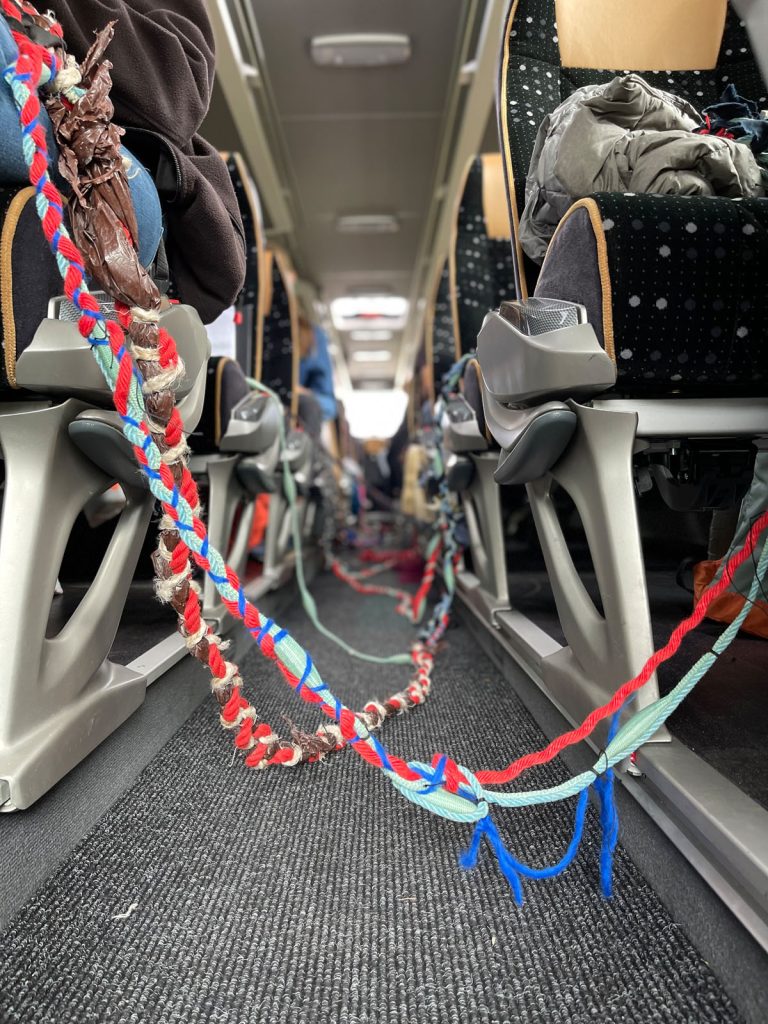
Braiding on the bus to Fogelstad, “Ho aj aj aj aj buff”, Sept.9, 2021.
THÉRÈSE: All the material for the braid you are making is trash from the forest, and trash from our and other people’s storages. Or, trash by the way, no; treasures! I’m starting to get troll perception because nowadays I get fascinated when I find treasures out there. Although it was a bit too much with covid masks and cigarette butts.
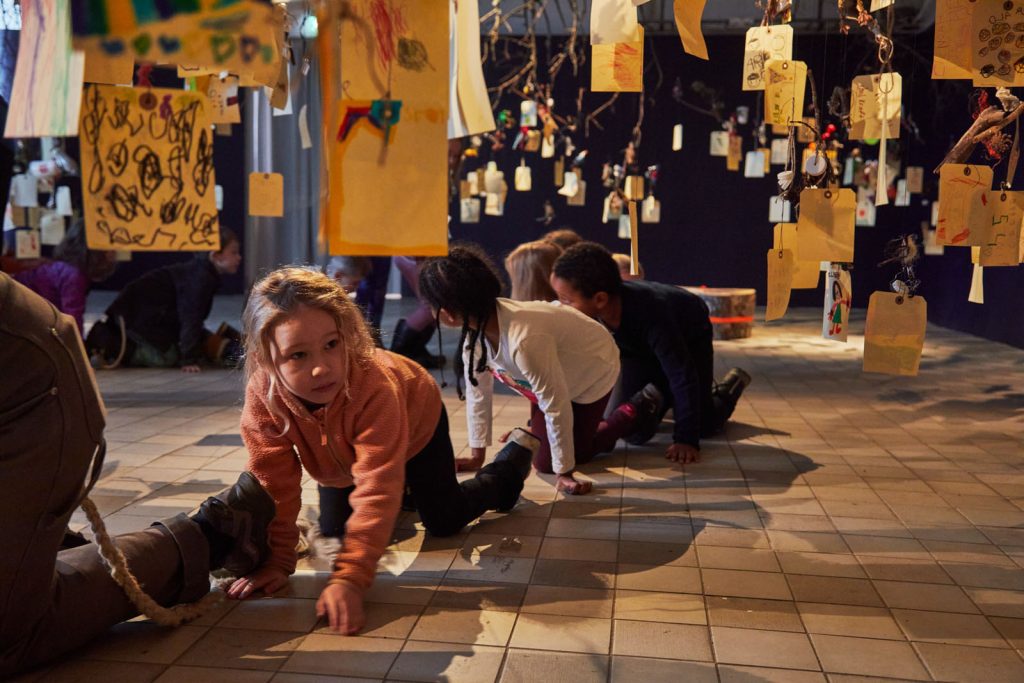
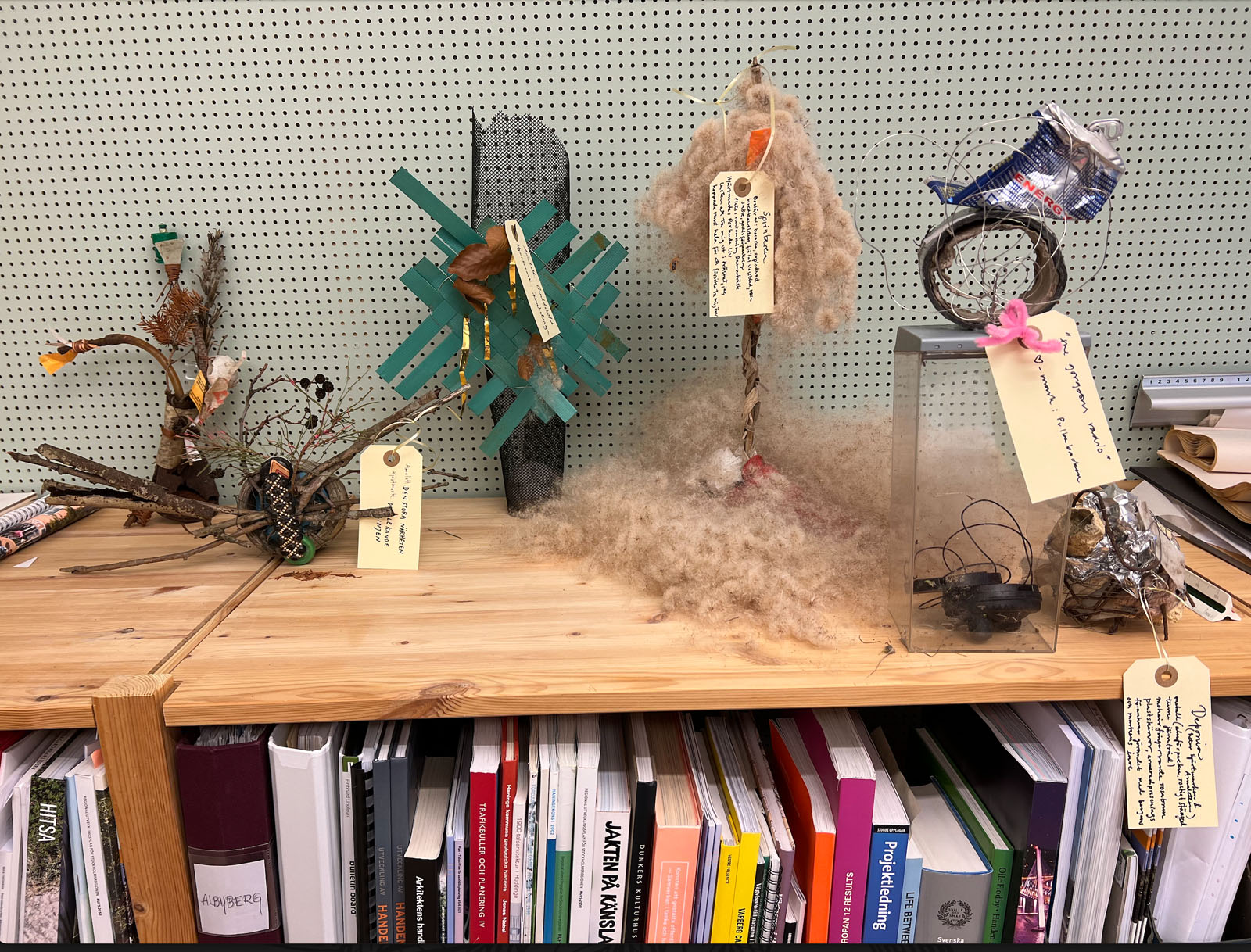
Amulets (turning trash into treasures), MYCKET and 300 five-year-olds in Farsta, ‘Troll hittar skatter’ exhibition at Konsthall C, part of ‘Art in Pre-school’, November 2023. Photo: Louise Helmfrid
KATARINA: Haha, well, I suggested that maybe you could wash them…
THÉRÈSE: Yes, but your best trade, the brown planting foil from the poplar plantation, I actually did wash it. It is beautiful when the plastic shines.
KATARINA: Certainly. But when I sculpt with it, it’s good that the clay remains. Helps maintain structure. And then it leaves pretty traces behind when the clay dries, crumbles.
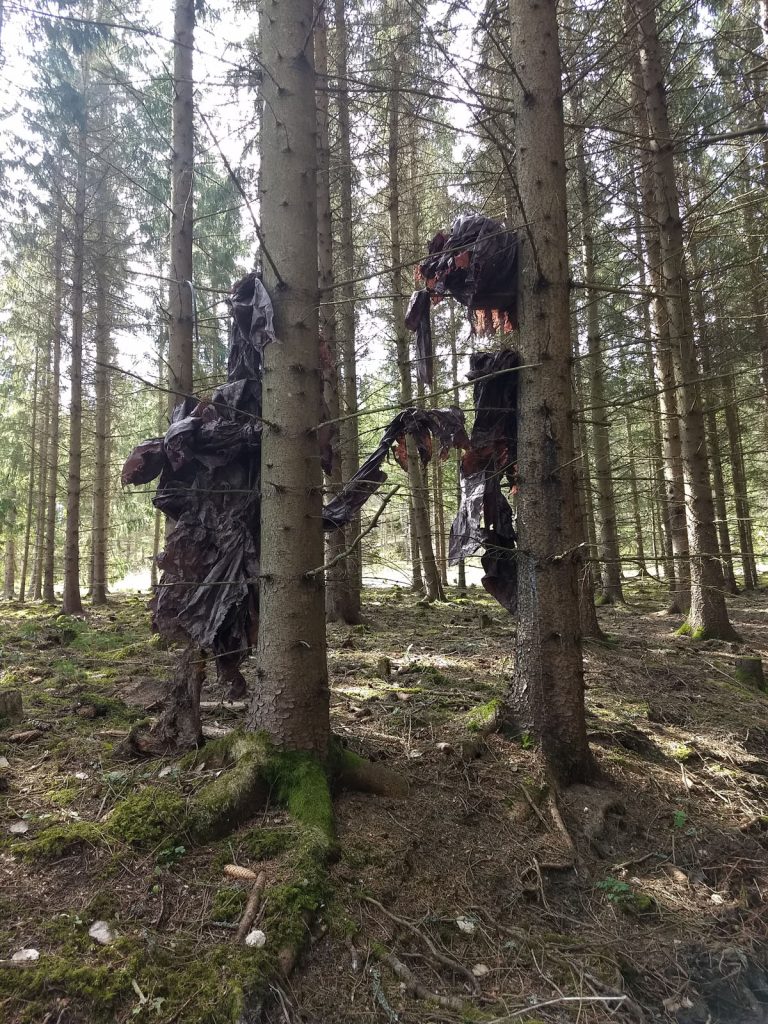
Forest friends of found plantation foil, Lesbian Valley, 2020.
MARIANA: The stories about the materials are part of the braids that unite us with those who have been here before and those who will come after. The elders have braided the hair of the young for generations, for thousands of years, the young will in turn run their fingers through the curls of the future generation[5].
THÉRÈSE: The problem is that we have all been forced to become part of the murderer’s story. The heroic success story where the earth is a resource to be snatched away.
KATARINA: A braid that Ursula pulls out has traces of Virginia Woolf’s braiding hands, she who reinvents the English language to tell another story. Virginia begins with a word list (a braid of words). She defines ‘heroism’ as “botulism”, from the word “bottle”. And the hero, in Woolf’s dictionary, is “the bottle”[6].
THE BUS AUDIENCE: Haha, the hero as a bottle, a very clear reassessment!
URSULA: Rahahhaw
It’s Ursula posting a bear laugh. Ursula has miraculously heard the bus audience in a twilight zone connecting the bus with the lake in a fourth dimension. Bears have very good hearing.
URSULA: I suggest that it is the bottle itself that is our story. Not just the bottle of gin or wine, but the bottle as a container, a thing that holds something else.
If you don’t have something to put things in, food will slip away from you – even something as small as an oat kernel. You put as many as you can into the stomach, the primary container; but what about tomorrow? Wouldn’t it be good then with a container? To put the oats in? Maybe another container in the form of a slung to put the child or pet in so you can collect the oats with both hands?
The story based on the container being man’s original design grounds me in a human culture in a way I’ve never felt grounded before.
As long as human culture is told as deriving from the use of long, hard objects to stab and kill (and by extension shoot, bomb and conquer) I want no part of that, I don’t want to be human, then I’d rather rest in the harbor of the bear.
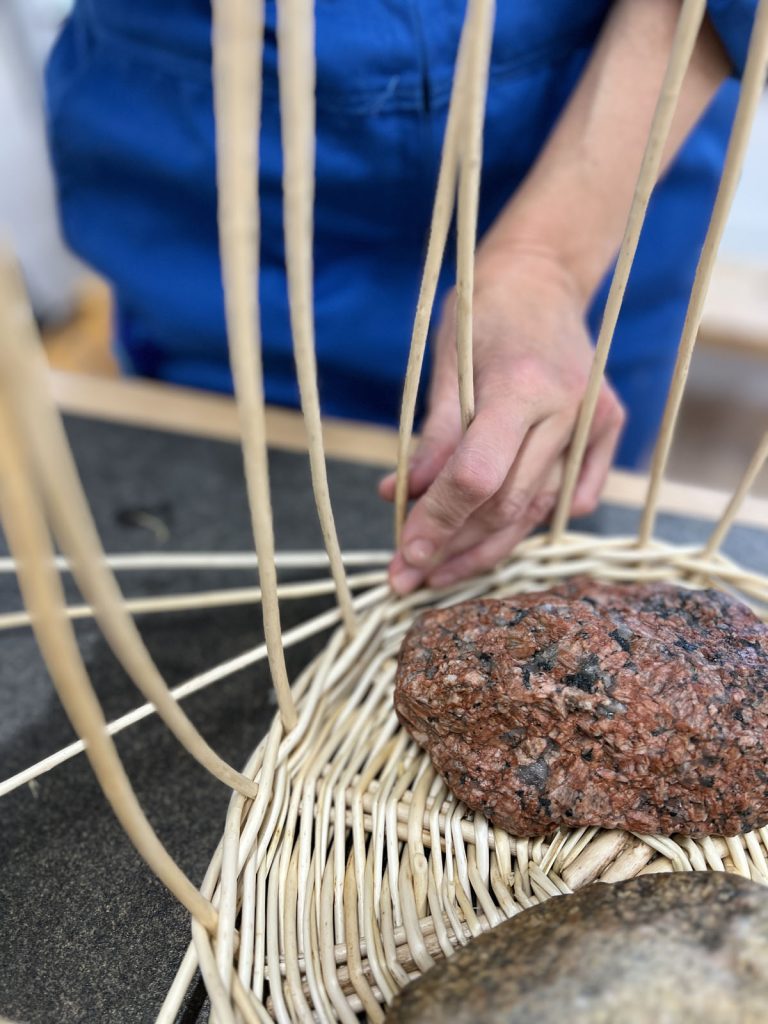
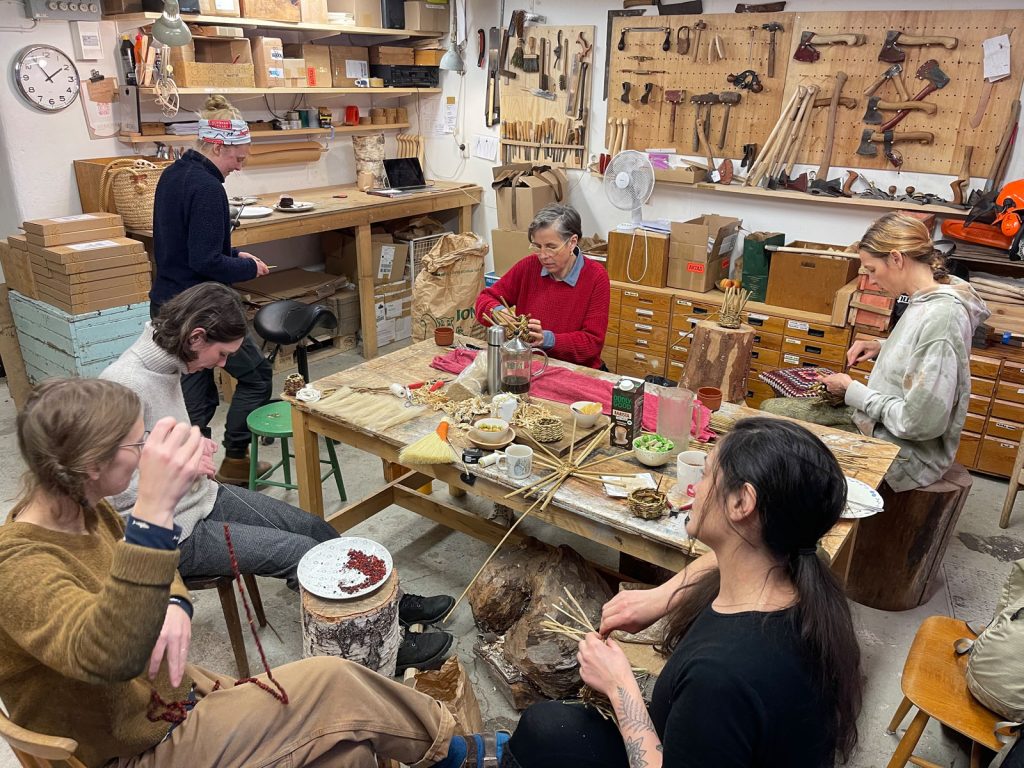
Basket weaving at ‘TrollLab’ with fellow design researchers, Malmö, Nov.19, 2023. Learning techniques of basket weaving as a means to create out of that which is overseen in contemporary society is part of the artistic research project. For instance after a snowstorm we can collect a large amount of long and thin willow from the ground which are great material for baskets. We’ve been taught how to weave through Sörmlands museum and the Basket Club, held by crafters Sorella Tavares and Julia Kalthoff.
Ursula has stood up during her exposition, swaying now and then, like a caged animal. Disturbing the little trolls under the tufts and moss. A dry, ancient wretch, namely Skord, becomes wide awake. Shakes and jumps up. Ursula’s story brings to memory Skord’s first meeting with a human[7]. They recall:
SKORD: At its side, the device had something resembling a birch tick but made of hairless skin. From it he took up a large ear and tore small pieces of it and threw against the thicket. Quickly a Siberian jay [‘lavskrika’ in Swedish] was there and grabbed the flake. This was repeated several times. In the end, I became so curious about those little ear slivers that I pinched one. When I had fumbled with it for a while, I concluded that it was suitable for stuffing in our mouth because it smelled like white clover or almond blossom and inside it was shaped like the crumb of a large butterfly caterpillar. I ate it, and it was good. It was the best I had ever eaten. It was goodness itself.
Skord is getting hungry from the memory. Snatches the butter-fried chanterelles from the murika and smoothly dives into the Rödbraket. Smeary by mud, the troll floats away. The people busy with their stories and doings don’t notice anything. Well, Ursula is completely absorbed by her account.
URSULA: So, it is the story that makes the difference. It is the story that hid my humanity from me. The story told by the mammoth hunters of stabbing, raping, killing – that of the hero. The murderer’s story. Therefore, it is with a certain sense of urgency that I seek nature, the words of other stories, the unspoken life stories. They are unfamiliar, they do not come easily to the lips as the killer’s stories do.
ACHE: Mais, quand même, tacit “unspoken” that’s an exaggeration, isn’t it?
URSULA: Yeah, true, people have been telling life stories for ages, in all sorts of words: Myths of creation and transformation, folktales, the stories of trollfolk and changelings, even novels. My point is that if we stop thinking of the story as a linear story of the hero, and instead see it as a container, a cultural carrying device, perhaps what we now perceive as fiction is closer to our reality than the story of the hero who slaughters and dominates.
Ursula has a plastic bag spread out in front of her, there is a collection from the forest. She picks up a beechnut and cuts a cross section. Throws one half to the tame wild pig “Zabka”, who pokes his snout out of a sloeberry bush when he smells the beechnut. Zabka skillfully catches the nut in the air[8]. Ursula holds up the other half and speaks.
Basket weaving at ‘TrollLab’ with fellow design researchers, Malmö, Nov.19, 2023. Learning techniques of basket weaving as a means to create out of that which is overseen in contemporary society is part of the artistic research project. For instance after a snowstorm we can collect a large amount of long and thin willow from the ground which are great material for baskets. We’ve been taught how to weave through Sörmlands museum and the Basket Club, held by crafters Sorella Tavares and Julia Kalthoff.
‘Tıa’s dinner with absent friends’ (Zabka and Simona Kossak), Lesbian Valley, May 20, 2021.
URSULA: See, the beechnut is triangular in cross-section. It belongs to itself. And is a gift from the tree. When the pigs dig the soil in the beech forest, they prepare for certain nuts to take root while also feeding themselves. The forest teaches us by acting as a role model. Here!
She throws the other half and a fistful of nuts to Zabka, who starts searching and munching.
KATARINA addressing the bus: If you listen, you can actually hear how the forest resonates.
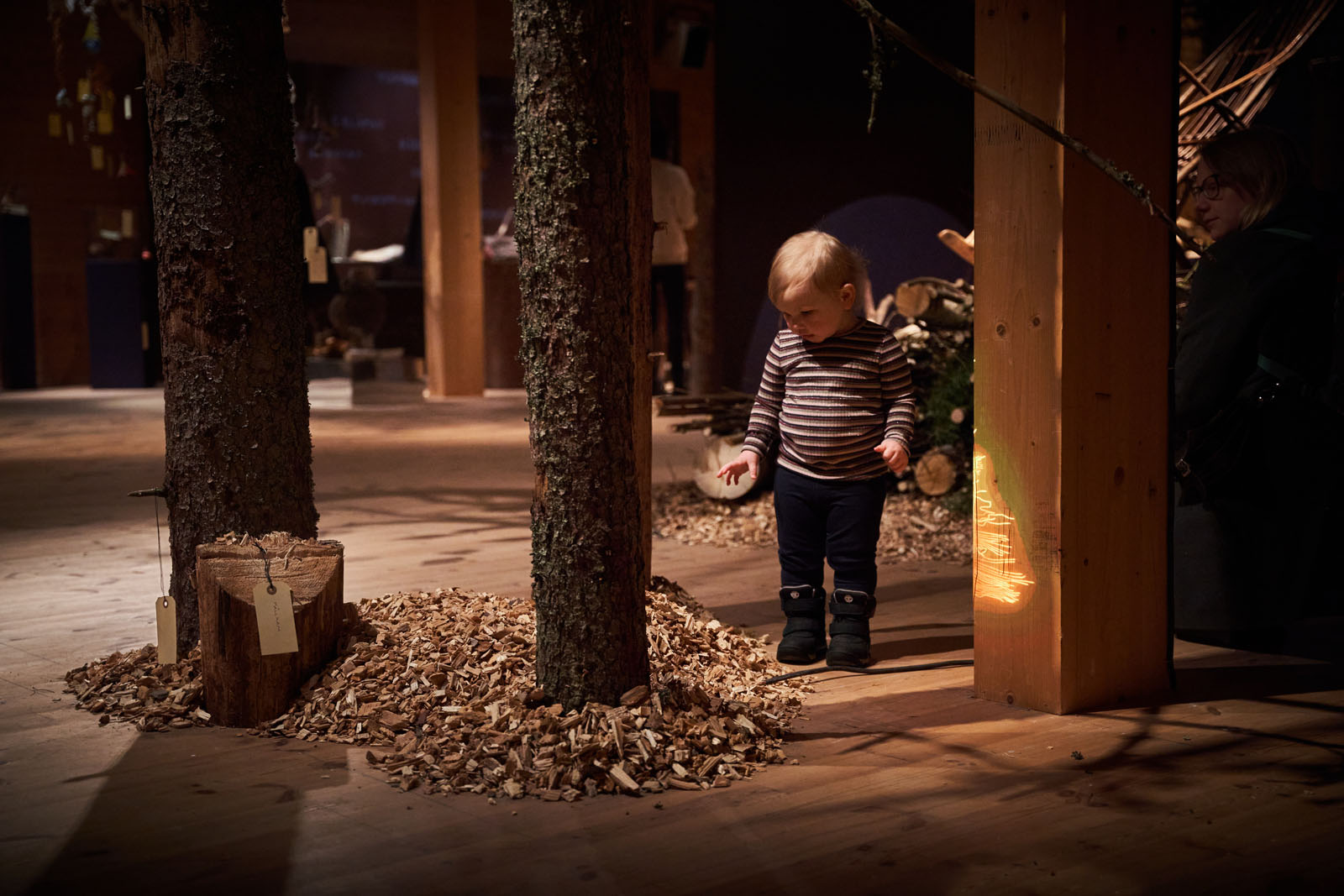
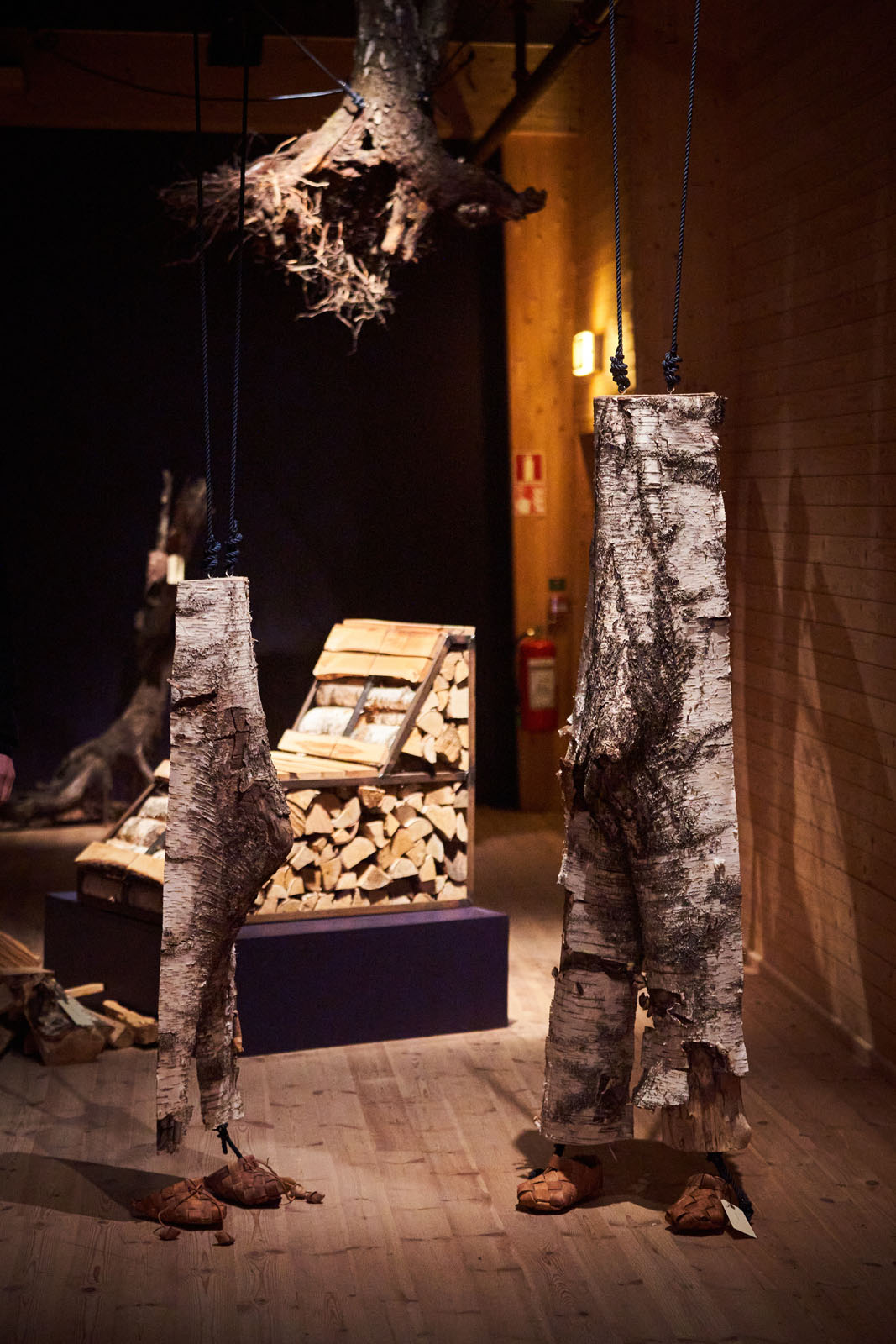
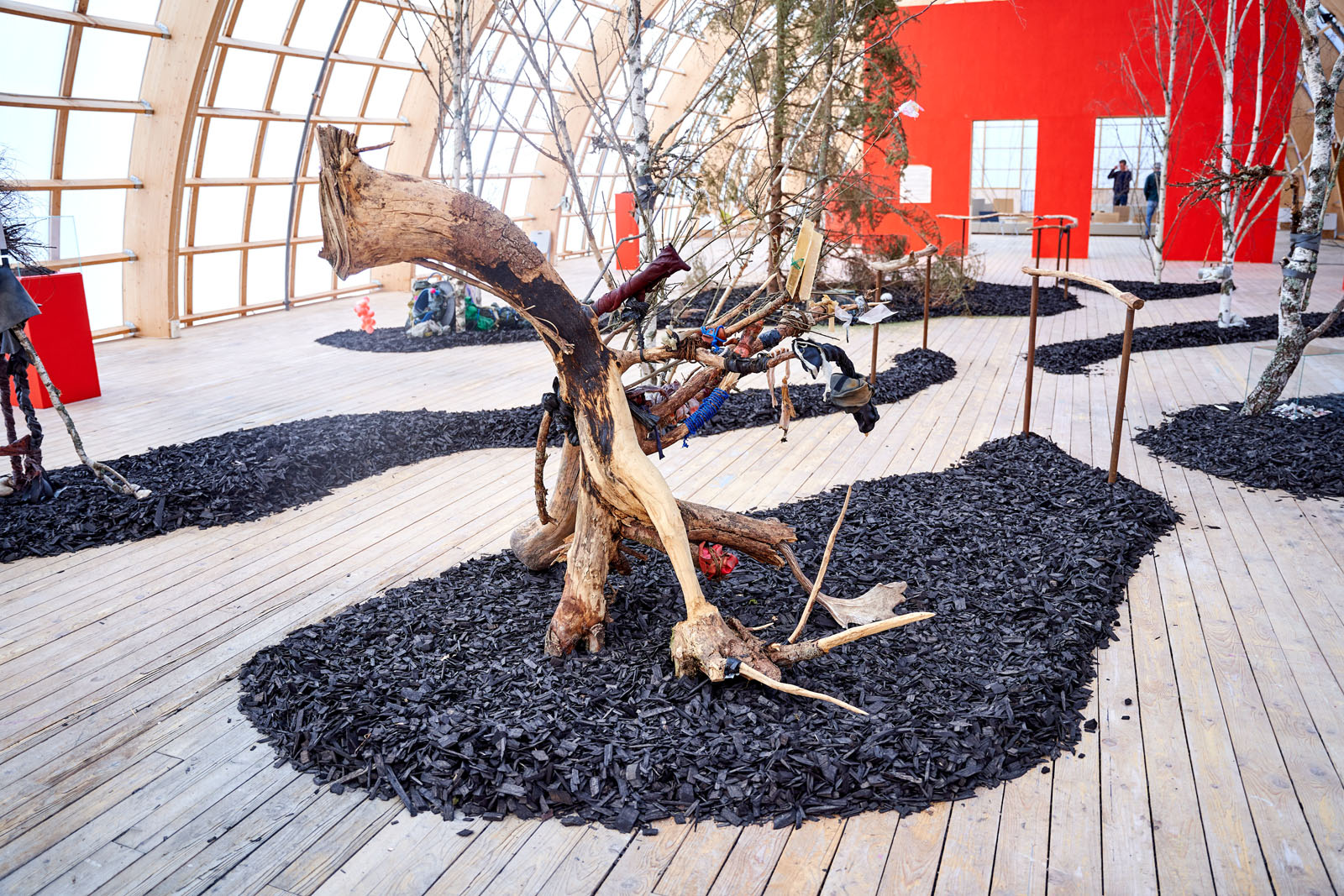
In the exhibitions ‘Forest Madness – delusions about wounds’ and ‘What are the forests up to – Wood 2022’ at Virserum kunsthalle (2022), field recordings of spruce and our office-based aloe vera plant were the soundtrack of animated spruce bark beetles and other creatures. Photo: Myra Wippler
We’ve been helped by sound designer Madde Edlund and contact microphones to be able to hear the protruding roots in the beech forest. We’ve also gotten beautiful help from Robin, who can interpret the trees. She translates so we understand what we hear. That is, Robin Wall Kimmerer, the botanist who in “Braiding Sweetgrass” tells about the council of pecan trees[9]. She’s also present by the fire, with a red home-knit sweater, sitting next to Ursula. She’s probably the calmest in this bunch. Through her we can hear the trees:
TREES: Stick together. Act like one. Learn the strength of unity.
We have learned that there is strength in unity, a single individual can be weeded out as easily as a single tree that has borne fruit in the wrong season. We don’t bear fruit every year, but when we do, we do it in sync. All trees across the continent at once. The few nuts that a single tree can produce are not enough. There must be an abundance, then squirrels and pigs can eat their fill and other small nuts can take root to new plants.
Now Robin breaks in with a soft melodic voice (she respects the small trolls who are sleeping).
ROBIN: How do the trees agree when it’s time to bloom? It is still beyond our understanding. Science has claimed that it is purely rational, that observation is independent of the observer. And yet scientists have concluded that plants cannot communicate because they lack the capacity of animals to speak.
But pollen has been carried by the wind for eons of time to create these nuts. If the wind can be entrusted with such a great responsibility, why shouldn’t it also be able to carry messages? There is much we cannot understand based on our human capacity. They may speak with pheromones, hormone-like compounds carried on by the breeze. Is that how they synchronize when they must carry nuts and balls?
Or, do they communicate underground? The groves in the forest are linked by networks of mycorrhiza (fungal roots). That is, fungal threads (mycelium) intertwined in symbiosis with tree roots. The fungus helps the plant absorb water and nutrient salts, while at the same time receiving organic compounds from the plant. The fungus can also give the plant antibiotics as a defense against invaders. Moreover, they seem to act as the Robin Hood of the underworld, taking from the poor and giving to the rich, redistributing carbohydrates from tree to tree, weaving a web of reciprocity, of giving and taking. In this way, all trees act as one tree because the fungus has united them.
Robin’s words are reinforced by the beech forest:
TREES: Through unity, survival.
All flourishing is mutual.
Soil, mushroom, tree, squirrel, boar, human – all are beneficiaries of this reciprocity.
KATARINA addressing the bus: This abundant generosity, they give of themselves so that others may live. And at the same time, through the gift they protect their own life. The gift’s logic of reciprocity. But after fifty years, I still don’t understand how to thank the apple trees for the fruit, the elder bushes for their bunches of flowers, the rush for their stems, the spruce for their roots, the patches of wild strawberry for their sweetness.
THÉRÈSE: Yes, like: Huh? For me? It’s way too much…
MARIANA: Or it’s a stupid question with a very simple answer: Eat them!
KATARINA: Häpp!! Although with help from Robin I’ve come up with one thing that I do[10]. I peel away patches of the thick grass so that the roots of the wild strawberry plant can find their way into the soil. Not seldom do I find plastic, slagg or some glass shard when I start digging in the soil. The soil is always contaminated.
[silence]
MARIANA: The Mother Troll must have fallen asleep herself, I can hear her quiet breathing rustling in the treetops. Or is it just the noise from the highway?
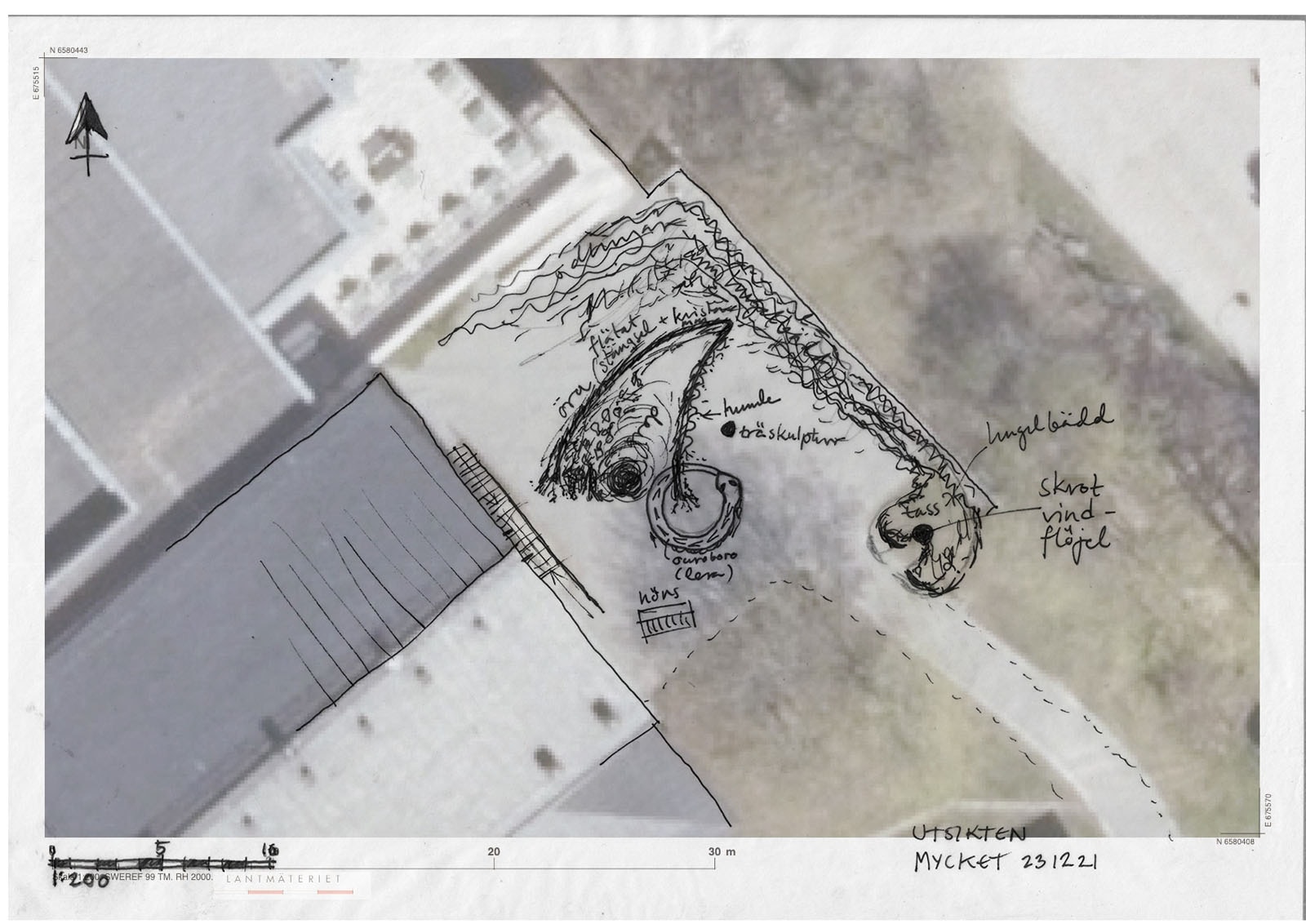
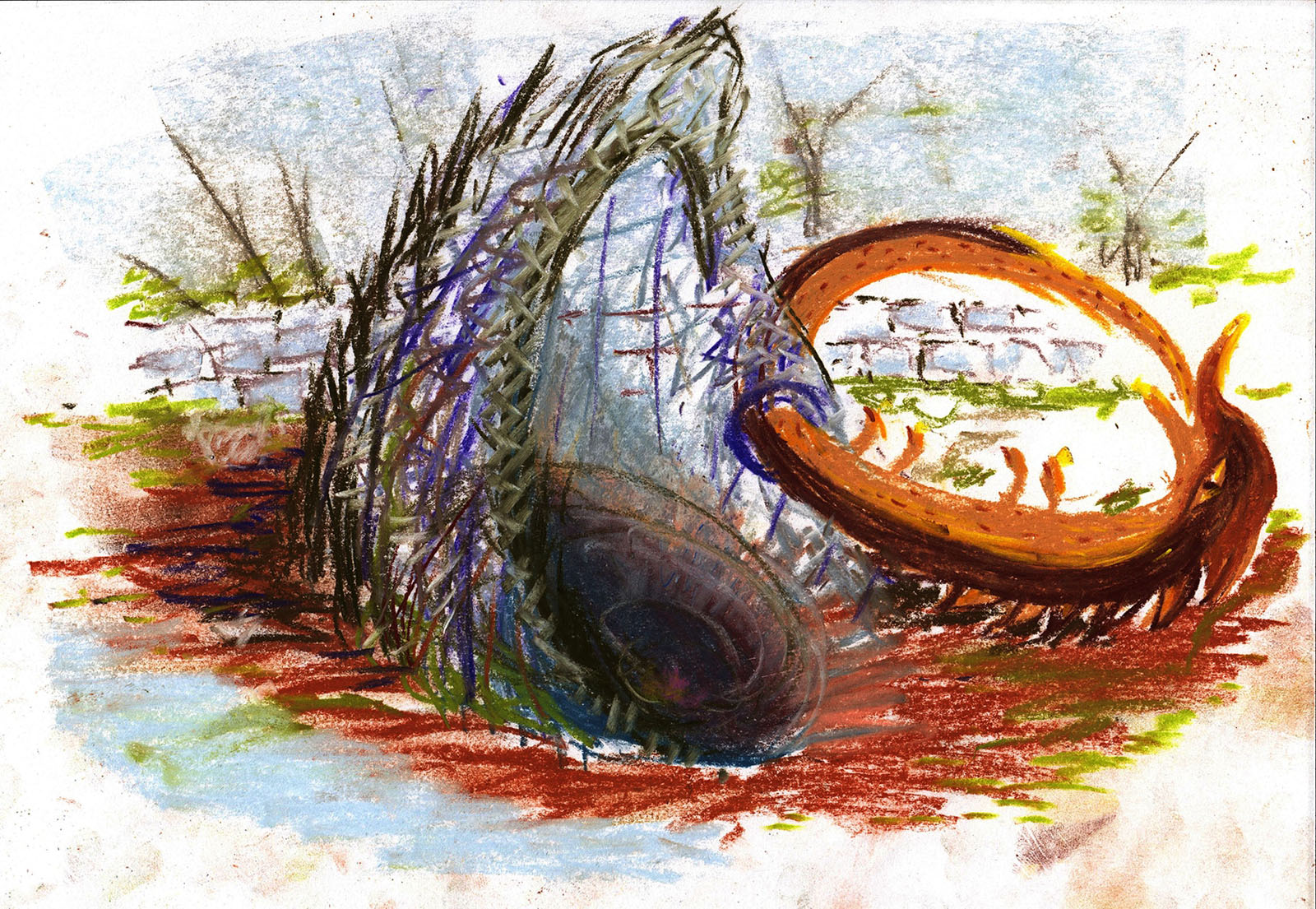
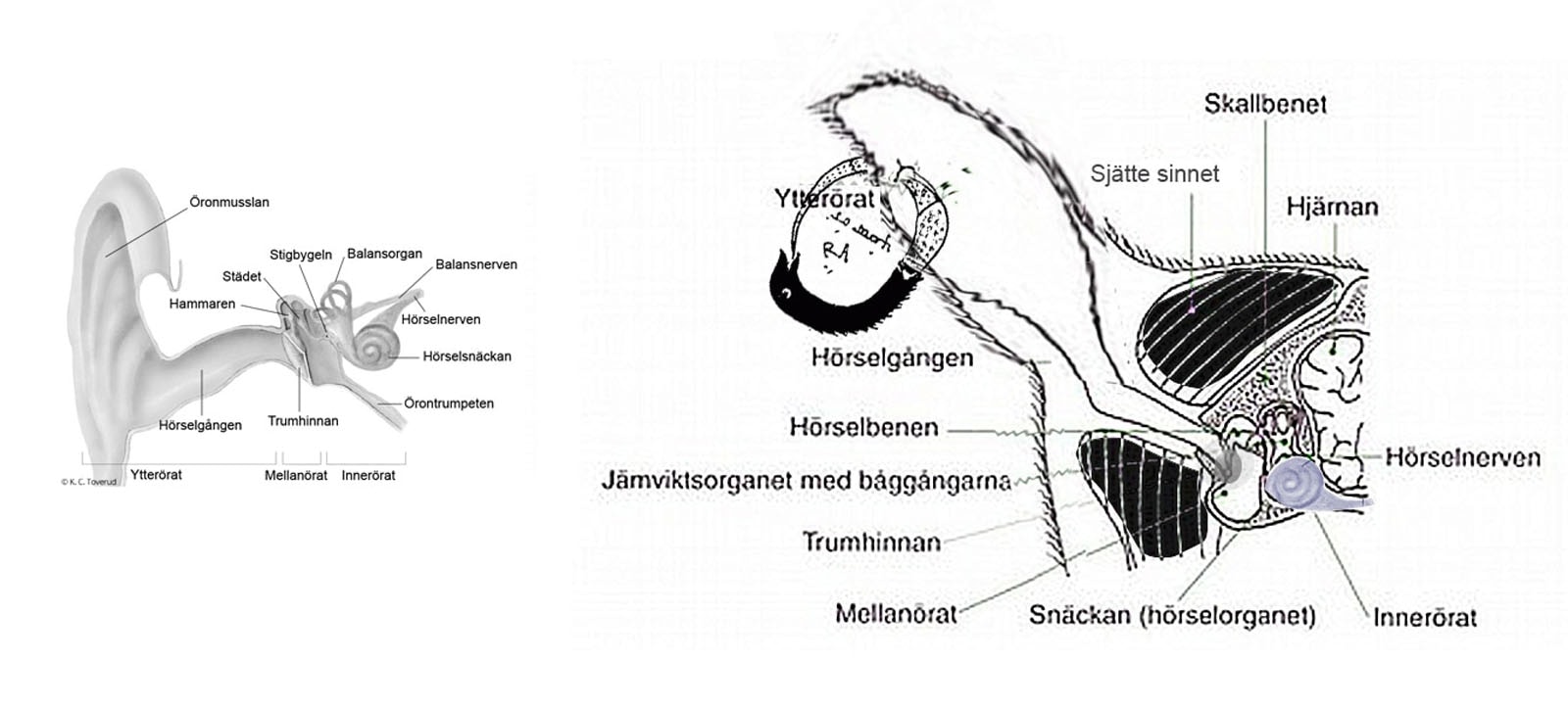
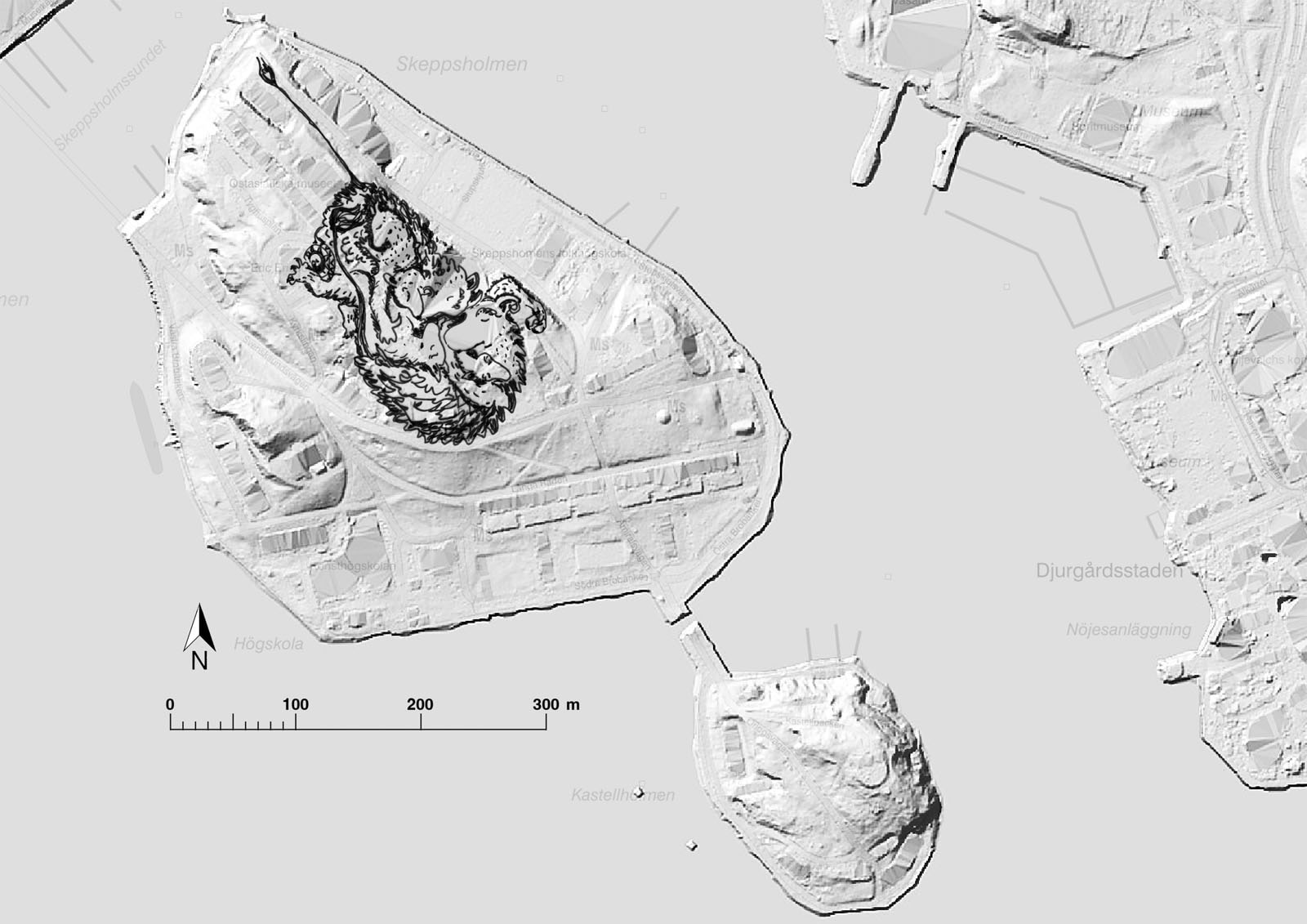
The primeval rock underneath Moderna museet and ArkDes at Skeppsholmen in Stockholm is approximately 2000 million years old. In a close study of the geological map we have come to believe that the rock formation might actually be a pack of sleeping trolls. We can even see an ear poking up from the ground. Perhaps, if we gently wake them up, they can teach us humans to live as part of the ecosystem? ArkDes, June-Aug, 2024.
KATARINA: I wonder where the troll Skord went?
THÉRÈSE: I see Skords’ old scurvy cap floating over the lake, past the embankment and the fallen tree, on which trollsmör/troll’s butter, glansgryn/glitter grits and vargmjölk/wolf’s milk (all diffferent kinds of slime molds) slowly travel along the bark. The steady current of water carries Skord further into the canal, past the hut that was moved here by those building restoration people a few years ago, remember them? They later divorced. Here by the hut, Skord receives another recollection, namely from an incident 500 years ago when Skord was able to figure out what dwellings and houses were good for – and eventually what they represented.
SKORD: Peeking through the door, I could see how they had caught the fire inside. The raging and roaring fire that could burn down an entire forest so that only black hills, smoking stumps and vole holes in the ground remained.
Inside, they kept the fire trapped in a pit, or spell bound on rocks. It did not burn them. It did not throw itself over the interiors of the houses with fluttering jaws, but warmed kindly like a sunshine over a meadow and shone beautifully on their faces. They honored it and gave it firewood and sticks. In return, it warmed their kettles and frying pans. They were almost overconfident with the fire in the same way a tiny man can be with a big bull or a stallion. He can lead the bull in a nose ring and keep the horse in a bridle, although it foams with green froth and anger.
Out of curiosity, I finally went into a house, even though I was stung by fright. It was dark inside and the fire gleamed on the hearth. The smoke went up with fire sparks into a hole in the ceiling. I looked in the hole and suddenly understood everything. They had made the hole so that the fire could get where it wanted and at the same time stay with them. These streams of sparks flowed between them and the sun. I no longer knew in which direction they were going. From the sun? Towards the sun?
Now I knew what houses were for. Here you did not pee on the floor. The creatures that did not know better did, of course, the piglets and the puppies. Neither did the hens seem to understand the significance of the place. They were here to be animals in the forest.
And now I realized that the house was made as a metaphor of the forest. The tree trunks rose to the sky. The ground was covered with rustling dry grass and fir needles. A cairn was set below the sky hole which was their sun. The animals unknowingly went about in their doings. Only the people knew what they had done. They liked metaphors. They had made an image of the forest. Here it was not a green mess, not brushwood and sticks and ruggedness, but order. They had the sun in a bridle and the moon in a nose ring. They had water in jugs not rushing down rock faces. They were sensible and ingenious and, above all inconceivably skilled. They had even made a grotto in the forest and where they crawled in and stayed when darkness fell. They dug down food like bears and foxes do, and pulled it out again when they wanted to eat[11].
Harvesting rush at the lake Hunn together with Tracy Jonsson, director of Rejmyre Art Lab and harvesting spruce roots along Östgötaleden in the Lesbian Valley, Sankt Anna, Östergötland. When harvesting spruce roots you have to know what you’re doing, be thoughtful and not harvest too much, as well as have the permission of the forest owner.
THÉRÈSE addressing the bus: With this troll perception of people’s need for stories and images, which we borrowed from Kerstin Ekman’s novel The Forest of Hours (in Swedish ‘Rövarna i Skuleskogen’), we round off our speech. You are welcome to continue braiding.
The branched capillary braids of both buses will this afternoon be woven together into a strong cradle suspended in the forest, between two fir-trees. A swaying architecture, a container for you to lean against and slowly rock from one side to the other.
How do trolls relate to boundaries? Not at all. A border is a real physical obstacle – a body of water too big to cross, a mountain too high to climb. That is, if you can’t take a giant leap or open the gate that leads you into the mountain.
The cradle will remain in the forest for a time, affected by life, weather and wind. But will later return home again to our heartlands by the lake Rödbraket.
Thanks for coming along for the ride!
Mother troll’s cradle hanging in the forest near Fogelstad.

‘Skapande Skola’ (appr. ‘Creative School’), workshop with Sankt Anna School, Rödbraket, the Lesbian Valley, Östergötland, May 24, 2022.
Epilogue:
The mother troll’s cradle was left to hang in the forest near Fogelstad until October 25, 2021. The forest had grown on with needles, leaves and twigs. As we tangled, packed and carried it out of there, we encountered a dollop of butter. Trollsmör (troll’s butter, in Latin ‘Fuligo septica’) is a kind of slime mold which is more of an animal than a fungi. It was clearly headed for the cradle. In human terms, we had been in too much of a hurry and the butter never arrived.
Later, The Mother Troll’s cradle hung in Virserum’s kunsthalle, as part of our exhibition “WOOD 2022 – what’s going on with the forests?” (10/4 – 27/11 2022).

Mother troll’s cradle, Virserum kunsthalle, 2022. Photo: Myra Wippler
You are welcome to gently crawl into the cradle, maybe even tie your tail to it?
/Mariana, Thérèse & Katarina
Notes
[1] “It is either a climate solidarity pact, or a collective suicide pact.”, UN chief António Guterres warned world leaders at the opening speech of the global climate conference in Egypt 2022.
[2] Those flawed tails that once we tie them together become strong, as researcher Christina Zetterlund tells us: ”A single thread is weak, but a braid is strong.”
[3] Ursula K Le Guin, The Carrier Bag Theory of Fiction (1986), theanarchistlibrary.org, p.1-7. We were introduced to this text by the sourdough Herman, an important co-creator in LNU-alumni Laura Fähndrichs’ and
Suzanne Skölds’ exploration on co-living and householding. Once Herman resided in our fridges, we named them Jässika & Hermana ;).
[4] Hélène Cixous,
[5] We shiver with pleasure when watching the music video for Zhalas song I’m in love (2015) directed by Roxy Farhat.
[6] Virgian Wolf, Three Guineas, 1938.
[7] Skord is the main character in Kerstin Ekman’s novel The Forest of Hours (original title: Rövarna i Skuleskogen, first published in 1988).
[8] Zabka is Simona Kossak’s tame wild pig that she spent time with in the ranger’s cabin in Bialowieza, the primeval forest.
[9] Robin Wall Kimmerer, Braiding Sweetgrass. Indigenous Wisdom, Scientific Knowledge and the Teachings of Plants (Milkweed editions, 2013), p. 11-21.
[10] In the third chapter of Braiding Sweetgrass Robin Wall Kimmerer explains the idea of wild strawberries as being gifts from the earth and how that gift made her see the land as generous and loving, wanting her to be generous back to the strawberry plant by tending to it.
[11] Kerstin Ekman, The Forest of Hours, p.23.
↑ Top