
(Plastic) Waste to Plate – The Journey of Microplastic into our Food System
An exploration of how we, humans, add microplastic into our food system and hence into our bodies. Plastic has many desirable material properties and has become an essential part of our modern life over the last decades. However, due to improper plastic waste management and littering, microplastic, tiny particles resulting from the degradation of plastic, can be found ubiquitous in the environment and in us humans. They are in the air we breathe, the water we drink, sediments, as well as terrestrial and aquatic organisms. This causes the global issue of plastic pollution and its adverse impacts on the environment, animals and human well-being. Despite this, big corporations continue to produce plastic products, especially single-use plastic packaging every year (Toussaint et al., 2019; Barboza et al., 2018; Rozsa, 2021; Francis, 2022).
Throughout my research, I noticed this topic is not often talked about among social media, the public nor the government yet it arises as a topic which needs attention. Waste to Plate aims to bring the topic of microplastic in the food system closer to the general public via a dining workshop. The workshop was used as a tool to raise awareness and start a conversation about the issues.
The dining workshop mimics a formal setting with a table runner and a centerpiece for the grand aesthetic. The table runner contains illustrations and a short text explanation of the journey of microplastic, starting from its source of waste at the center of the table, moving outwards from both sides and entering essential food sources, including animal farms, and fruit and vegetable farms. The same infographic was provided on both sides of the table runner as I wanted the audience to have access to the same information. The image below shows half of the table runner.

I see design as a powerful tool to make change within society. I was challenged with how to communicate complex ideas in a journey that is easy to understand. Thus my graphic language used a friendly approach to the serious topic of microplastic contamination in food without blaming my participants for consuming plastic. My visual aesthetic is hand-drawn illustrations featuring thick lines and warm earth-tone colours to create a minimalist, playful, and textured infographic. The confetti-looking illustration represents the omnipresence of microplastics. It’s a recurring theme in all the cards and infographic table runners (Ruth, 2023; Lupi, 2014).
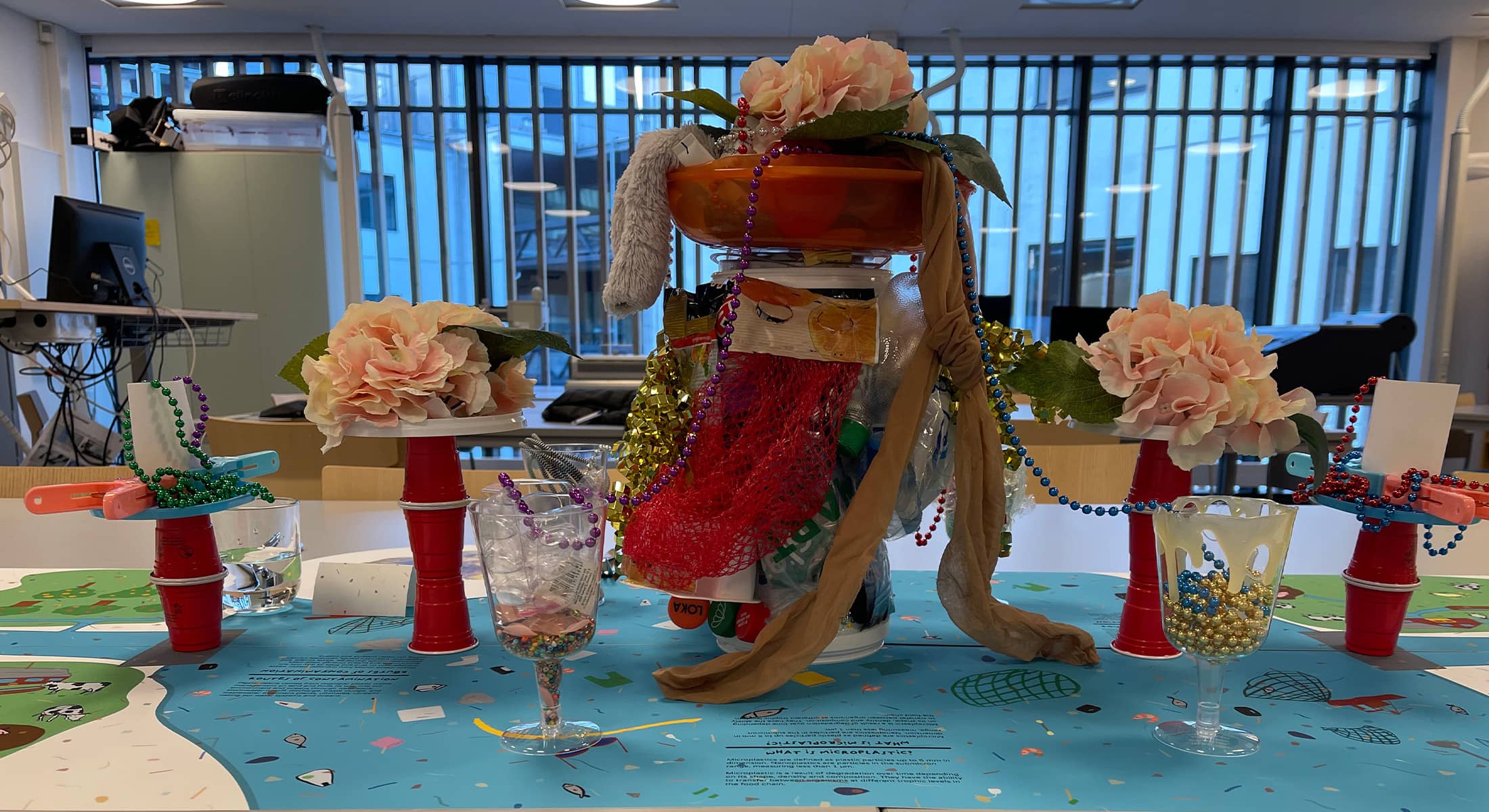
The centrepiece was inspired by Surtout de Table, aiming to give a grant feeling to the table while incorporating plastic waste into the pieces. The plastic flowers as decorations and shot cups were used as a base, to create layering. The beads were added to create flow and downward movement into the 4 wine cups, containing different types of commonly found plastic. This brings the issues of plastic pollution and waste even closer to the participants as they eat the food that may contain what is in front of them. Some participants said that it was efficient, visual and scary to think of the issues we humans created.


The dining workshop focuses on starting a conversation about the issue with the participants by incorporating meals in between. Each meal has a theme; the starter focuses on the history and origin of packaging materials, the main course focuses on the issues and challenges of microplastic and the dessert focuses on possible solutions.

“I was aware of plastic pollution in the ocean, but I did not know about microplastics in our food, air, and even our bodies!” – Workshop participant
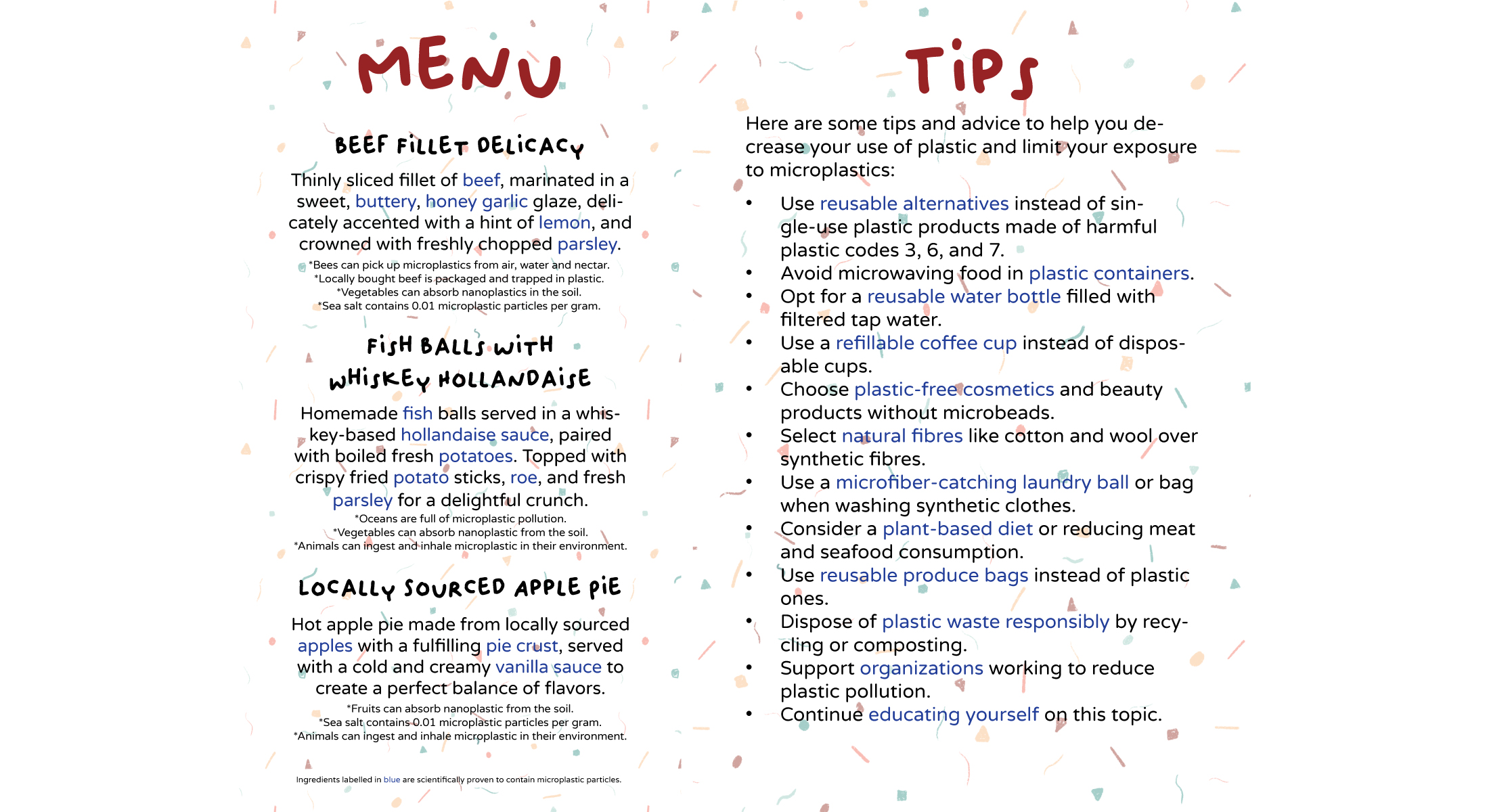
By collaborating with Joel, we created a 3-course Swedish meal with locally sourced ingredients. These dishes highlighted certain ingredients that have been scientifically proven to contain microplastic. While connecting back to the local environment, bring it closer to the participants. Edible glitter was added to every dish to emphasize the small size of microplastics that are often invisible to the naked eye.


The most important insight I gained from this workshop highlighted the desire for change in society towards a better, cleaner, and more sustainable world. I realized that people are willing to learn and adapt their lifestyles if the necessary resources and solutions are available. Unfortunately, little to no information is commonly available to the public. Throughout my work on the project, I was able to bring the issue of microplastics in food closer to the public through my design as a +Change student. By combining my passions for food and well-being with infographics, sculpture, and workshops, I can raise more awareness by hosting the workshop in different locations. This project serves as an inspiration for a friendly approach to a serious and concerning topic through design and change-making. This project is an example of how design and change-making can be used to approach serious and concerning topics in a friendly way.
References
Barboza, L. G. A., Dick Vethaak, A., Lavorante, B. R. B. O., Lundebye, A.-K., & Guilhermino, L. (2018). Marine microplastic debris: An emerging issue for food security, food safety and human health. Marine Pollution Bulletin, 133, 336–348. https://doi.org/10.1016/j.marpolbul.2018.05.047
Francis, A. (2022, October 5). How Much Microplastic Am I Eating? And Is There Any Way to Avoid It? Bon Appétit; Bon Appétit. https://www.bonappetit.com/story/microplastics-food#:~:text=Microplastics%20can%20even%20be%20found,a%20cup%20of%20Earl%20Gray.
Lupi, G. (2014). Plastic Air — giorgialupi. Giorgia Lupi. http://giorgialupi.com/plastic-air
Toussaint, B., Raffael, B., Angers-Loustau, A., Gilliland, D., Kestens, V., Petrillo, M., Rio-Echevarria, I. M., & Van den Eede, G. (2019). Review of micro- and nanoplastic contamination in the food chain [Review of Review of micro- and nanoplastic contamination in the food chain]. Food Additives & Contaminants: Part A,36(5), 639–673. https://www.tandfonline.com/doi/full/10.1080/19440049.2019.1583381
Rozsa, M. (2021, April 10). How plastic pollution threatens our health, food systems, and civilization itself. Salon; Salon.com. https://www.salon.com/2021/04/10/how-plastic-pollution-threatens-our-health-food-systems-and-civilization-itself/
Ruth, P. (2023). Phthalo Ruth. Phthalo Ruth. https://phthaloruth.com/collections/frontpage
